Building a World of Play: Interactive Installations (2005–2009)
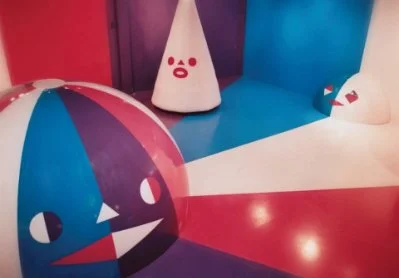
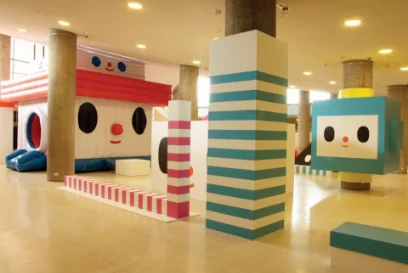
As their reputation grew, FriendsWithYou expanded from small plush talismans to room-sized, and then street-sized, installations. Miami's burgeoning art scene (energized by the launch of Art Basel Miami Beach in 2002) proved the perfect playground for Borkson and Sandoval's ambitions. In 2005, they unveiled “Cloud City” at the Museum of Contemporary Art's warehouse during Art Basel Miami, marking their first major foray into large-scale interactive art. Cloud City was exactly what its name evokes: an adventurous dream world playground assembled from giant geometric forms. Visitors entering the installation found themselves surrounded by oversize inflatable spheres and pillowy cones up to 10 feet tall, some mounted on casters so they could be rolled around with glee. The space was soft, bouncy, and drenched in bright colors. Formally, it felt like stepping inside one of FriendsWithYou's plush toys, enlarged to architectural scale. Simple shapes (the cone, the cylinder, the sphere) dominated the environment, their smooth surfaces inviting touch and interaction, while a few of these shapes bore the unmistakable minimalist face of a FriendsWithYou character: two black dot eyes and a small smiling curve. In fact, one recurring face belonged to a character called The Boy, an archetype the artists described as embodying youth and naïve creation. In Cloud City, The Boy and his geometric friends were not static sculptures but living parts of the story. Visitors could slide down fiberglass slopes, push around enormous foam creatures on wheels, and essentially become childlike players in this cartoonish city.
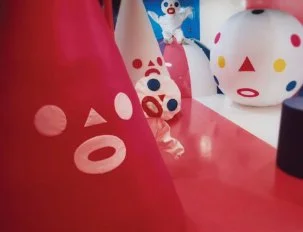
Cloud City established the collective's practice of “happy immersion”, and even came with its own soundtrack. FriendsWithYou released a music album featuring local Miami electronic artists to extend the dreamy experience into sound. The installation's success also foreshadowed how FriendsWithYou would merge art and entertainment: that same year, 2005, Cloud City spun off not only music but also motion graphics and animation (they began working on short animated pieces) and even a forthcoming monograph. By 2006, the German art press Die Gestalten Verlag published Friends With You Have Powers!, a book chronicling the collective's singular fusion of toys, graphics and interactive art. The title underscored the group's core belief: that there is power in friendship, play, and imagination.
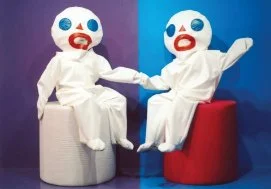
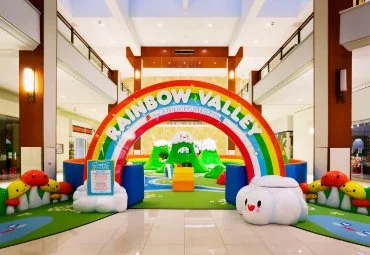
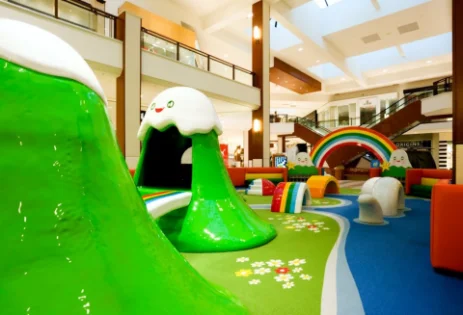
Miami's community embraced FriendsWithYou's playful spirituality. In December 2006, the city's Aventura Mall debuted “Rainbow Valley,” a permanent playground designed by the duo as part of an arts initiative. Unlike any typical mall playpen, Rainbow Valley was a land of soft mountains, rainbow bridges, and cloud slides, all foam-padded and rendered in vibrant colors. Children weren't just passing time here; they were engaging in a FriendsWithYou story. The installation came with a narrative about Peeko, a small pink mountain who loses his family and befriends a wandering cloud named Cloudy. together, they journey to the magical Rainbow Valley in search of playmates. This charming tale unfolded physically as kids crawled through Peeko's hollow mountain form or slid down Cloudy. By giving playground objects names and backstories, Borkson and Sandoval essentially breathed life (and soul) into inanimate forms, a direct expression of their animist philosophy. A journalist from Wired quipped that Rainbow Valley felt like “a warped Mario Brothers level,” noting how its fantastical design utterly transformed the experience of a commercial space. Indeed, through projects like this, FriendsWithYou began to demonstrate how art rooted in play could find its way into daily life (even a shopping mall) and still provoke wonder and connection.
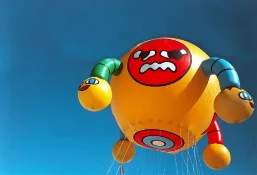
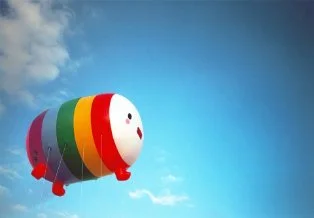
Back on the art fair circuit, FriendsWithYou kept pushing the envelope of interactivity and scale. For Art Basel Miami 2006, they dreamed up a one-of-a-kind performance piece: the “Skywalkers Parade.” This was a jubilant procession of gigantic balloons (5 to 60 feet wide) commissioned by Scion and co-created with fellow playful artists like Misaki Kawai and Paper Rad. On a December day, crowds watched a surreal parade of characters float in the Miami sky – a “collaborative way to tell a beautiful story through an enchanted parade,” as the artists explained. This early parade, with its mix of art and carnival, prefigured an even bigger parade moment for FriendsWithYou over a decade later, a moment when one of their characters would drift above millions in Manhattan. But in 2006, the Skywalkers Parade in Miami captured the collective's unorthodox approach: art didn't belong only on gallery walls, it could march down the street and make everyone stop and smile.
In 2007 and 2008, FriendsWithYou continued to alternate between gallery exhibitions and public art happenings. The Wish Come True show in late 2007 brought their magic to Minneapolis, while in 2008 the duo took Las Vegas by storm with “Fun House”, a bounce-house installation commissioned for the Hard Rock Hotel. Fun House was essentially a giant smiling inflatable castle, complete with a “romper room,” a funky restaurant, and even a pop-up FriendsWithYou toy store inside. Visitors could literally jump inside the art, unleashing their “inner brats” in what was described as an exercise in the “healing power of fun.” With its squishy walls and floating balls, Fun House was part playground, part contemporary art, blurring the line in a way that made some critics scratch their heads, but made participants grin from ear to ear. As the installation traveled to art fairs and even to the Welt Museum in Berlin in 2009, Borkson and Sandoval proved that their brand of whimsical, participatory art could resonate across cultures. It was during this period that observers started to note how FriendsWithYou “inverts the practice of religious traditions” (turning rituals into playful acts) “to open a connection to the divine”. By inviting adults to behave like carefree kids in a bounce castle, the artists were, in effect, performing a kind of secular revival meeting: a joyous, goofy one, but a spiritual communion nonetheless.
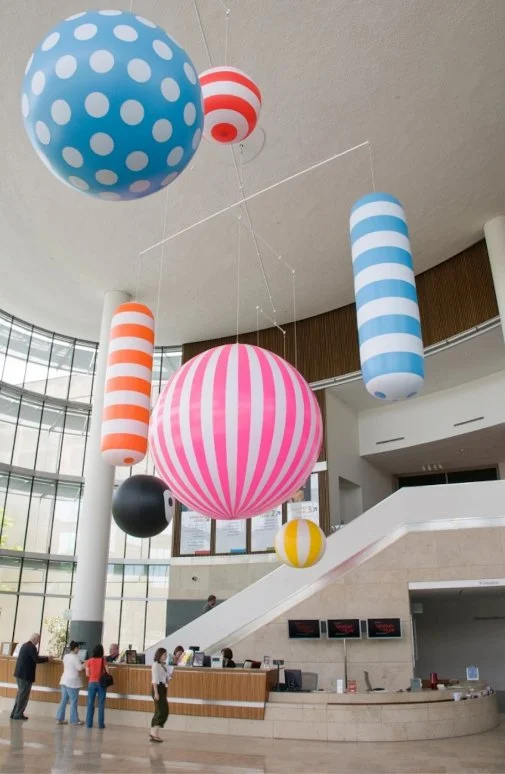
Even as they championed play, FriendsWithYou also explored quieter, contemplative work. In 2008, the Indianapolis Museum of Art exhibited their piece “Dream Maker”, a far more tranquil installation: a series of rotating fiberglass orbs painted as friendly planets and stars, like a miniature solar system mobile. Viewers wandering among these gently spinning “celestial beings” experienced a meditative calm, a shift in mood from the exuberant Fun House. This balance between raucous play and serene reflection would characterize FriendsWithYou's oeuvre going forward. Whether a piece was loud or quiet, gigantic or small, the goal was consistent: to trigger a sense of childlike openness and to reconnect people with fundamental feelings of happiness, curiosity, and empathy. “We use play as an artistic means to foster relationships,” the duo explained, hoping to activate “buried urges playfulness, laughter, and inquisitiveness with an end result of feeling connected.” In these years, one could see Borkson and Sandoval methodically constructing the building blocks of their own universe: one in which smiling faces, vibrant colors, and simple shapes became bridges between people, and between the people and some sense of the sublime.