… / / Modality and Technique: Collage vs. Computation
katsumimaki.com
General
  • Home
  • About
  • Start Here
Topics
  • Newsletters
    • Fanmade
      • Anti Group Tendencies
        • Page 1
        • Life as an “Anti-Group”
        • Afterword
      • Burnout
        • Page 1
        • Afterword
      • Empathy
        • Page 1
        • Afterword
      • Friendswithyou
        • Origins in Miami: Seeds of a Playful Universe (2002–2004)
        • Building a World of Play: Interactive Installations (2005–2009)
        • Rainbow City: Exploding onto the Global Stage (2010–2012)
        • Animism, Art, and “Happy Virus”: A Philosophy of Play
        • Collaborations and Pop Culture Crossovers (2013–2017)
        • Post-Internet Explorations: From Virtual Worlds to NFTs (2015–2022)
        • Conclusion: Pop Spiritualists in a Connected Era
      • From Dada Collages To Ai Art
        • Introduction and Personal Motivation
        • Dadaism: Collage and the Original “Anti-Art” Movement
        • AI-Generated Art: Algorithms as the New Collage
        • Comparing Dadaism and “AI-Artism”
        • Modality and Technique: Collage vs. Computation
        • Origins and Intentions: Art Movement vs. Tech Innovation
        • Reception and Cultural Impact: Anti-Art Manifesto vs. Existential Disruption
        • Outcomes and Future Trajectories: Lessons from Dada for AI Art
        • Conclusion: Art, AI, and Accessibility – A Personal Reflection
      • Lights Sound Printing
        • Page 1
        • Lighting: High Color Fidelity vs. Spectral Restriction
        • Audio: Theatre Mic Techniques for a Hybrid D&D Game
        • Digital Fabrication: From Desktop 3D Printing to Stage-Size Scenery
        • Conclusion: Personal Reflections on Tech in Theatre
      • Littlespaces
        • Overalls and Feeling Small
        • Voluntary vs. Involuntary Age Regression
        • Stress, Comfort, and Little Space
        • Age Regression vs. Age Play
        • The ABDL Identity and Spectrum
        • Community Norms, Safety, and Stigma
        • Unpacking Misconceptions
        • Afterword
      • Monoline
        • Origins, Purpose, and Brief History
        • Shel Silverstein’s Expressive Monoline Style
        • From Viral Outlines to Indie Cartoons: Monoline’s Digital Revival
        • Bridging Traditional and Digital: Community Art and Personal Practice
        • The Commercial and Algorithmic Appeal of Monoline
        • Communities and Culture: Constraints as a Creative Identity
        • Conclusion and Personal Reflections
        • Afterword
      • Never Have I Ever: Kinks
        • About Me
        • Aromantic Asexual Autonomy
        • A Space for Kink Exploration: Trials in Tainted Space
        • Consent and Customization in a Kinky Universe
        • From Kink Exploration to Relational Ethics
        • Doe Steele: The Trials in Tainted Space
        • Opening Up on Mhen’ga: Amber Changes the Game
        • Crew as Community
        • Relationship Anarchy Among the Stars
        • Afterword
      • Ps1lowpoly
        • Page 1
        • Early Low-Poly 3D: Console Limitations Shaping an Aesthetic
        • From Quirk to Art Form: Low-Poly Revival and Nostalgia
        • Modern Low-Poly in Contemporary Media and Art
        • Super Mario 64
        • Indie Animators and Series
        • Comedy Skits and Memes
        • Cozy vs. Creepy
        • Interview with an Appreciator
        • Conclusion
        • Afterword Fave (Interviewee)
      • Saved My Life
        • My Relationship With Food
        • My Trip to the Hospital
        • What My Journey Looks Like Now
        • Re-Learning My Purpose
        • Afterword
      • Slowart
        • Additive
        • Subtractive (Decay)
        • Performative
        • Slow-Change (Growth)
        • Latent Activation
        • Pilgrimage
        • Witnessing
        • Conclusion: Embracing the Art of Slow Moments
      • The Life Death And Afterlife Of Mannequins
        • I. The Enduring Allure of Mannequins
        • II. The Material and Historical Trajectory of Mannequins
        • Evolution from Functional Forms to Lifelike Figures
        • The Fiberglass Revolution: Durability and Mass Production
        • III. Mannequins as Cultural Artifacts: From Discarded to Desired
        • The Paradox of Invisibility and Persistent Presence
        • Sustainable Second Lives: The Mannequin Madness Model (Judi Henderson)
        • Table 2: Case Studies of Mannequin Reuse
        • The Uncanny Valley: Mannakin Hall as Experiential Art (Roz Edwards)
        • IV. Mannequins in the Human Imagination: Companionship and Projection
        • V. Reflections on Mannequin Endurance: A Personal Synthesis
      • Valentine
        • Page 1
        • A Sweet Gesture After Lockdown
        • Yearning vs. Attraction
        • Thought Experiments with a Safety Net
        • The Fun of Shipping (Even for the Aro-Ace Crowd)
        • Conclusion: Choose Your Own Valentine
    • Original
      • 2024-09 September
      • 2024-10 October
      • 2024-11 November
      • 2024-12 December
      • 2025-01 January
      • 2025-02 February
      • 2025-03 March
      • 2025-04 April
      • 2025-05 May
      • 2025-06 June
      • 2025-07 July
      • 2025-08 August
      • 2025-10 October
      • 2025-11 November
      • 2025-12 December
      • 2026-01 January
      • 2026-02 February
      • 2026-03 March
  • Stories
    • Fanmade
      • Daggerheart
        • CiCi
          • Page 1
          • Page 2
      • Dnd
        • Azurion Nightfall
          • Page 1
        • Little
          • Page 1
      • History
        • Prahlada and Malala
          • Page 1
          • Page 2
          • Page 3
          • Page 4
          • Page 5
          • Page 6
          • Page 7
          • Page 8
          • Page 9
          • Page 10
      • My Little Pony
        • Stellar Redux
          • Page 1
          • Page 2
          • Page 3
          • Page 4
      • Pathfinder
        • Occupation on Vesk 3
          • Page 1
          • Page 2
          • Page 3
          • Page 4
      • Satisfactory
        • Everroot
          • Page 1
        • Reaper and ADA
          • Chapter 1
          • Chapter 2
          • Chapter 3
          • Chapter 4
          • Chapter 5
          • Chapter 6
          • Chapter 7
          • Chapter 8
      • Star Trek
        • USS Mesa
          • Page 1
          • Page 2
          • Page 3
      • Star Wars
        • Protocols and Princesses
          • Page 1
        • Shakka'Dira
          • Page 1
          • Page 2
          • Page 3
          • Page 4
          • Page 5
          • Page 6
          • Page 7
          • Page 8
          • Page 9
      • Trolls
        • Rave and Relaxation
          • Page 1
    • Original
      • Neon Fairy Lights
        • Main Story
          • Page 1
          • Page 2
          • Page 3
          • Page 4
          • Page 5
          • Page 6
          • Page 7
          • Page 8
          • Page 9
          • Page 10
          • Page 11
          • Page 12
          • Page 13
          • Page 14
          • Page 15
      • Northern Lights
        • Main Story
          • Page 1
          • Page 2
          • Page 3
          • Page 4
          • Page 5
          • Page 6
      • Virtual World
        • Commands
          • 01 Bash
          • 02 Cat
          • 03 Ping
          • 04 Mint
          • 05 Vi
          • 06 Echo
          • 07 Dig
          • 08 Tar
          • 09 Sudo
          • 10 Kali
          • 11 Nano
          • 12 RPM
          • 13 Tail
          • 14 Grep
          • 15 Cron
          • 16 Alma
          • 17 Shell
          • 18 Yaml
          • 19 Sed
          • 20 Curl
        • Five Stories
          • 01 Cautious 01
          • 02 Desperate 01
          • 03 Fading 01
          • 04 Cautious 02
          • 05 Indifferent 01
          • 06 Gentle 01
          • 07 Cautious 03
          • 08 Desperate 02
          • 09 Fading 02
          • 10 Cautious 04
          • 11 Indifferent 02
          • 12 Gentle 02
          • 13 Cautious 05
          • 14 Desperate 03
          • 15 Fading 03
          • 16 Cautious 06
          • 17 Indifferent 03
          • 18 Gentle 03
          • 19 Cautious 07
          • 20 Desperate 04
          • 21 Fading 04
          • 22 Cautious 08
          • 23 Indifferent 04
          • 24 Gentle 04
          • 25 Cautious 09
          • 26 Desperate 05
          • 27 Fading 05
          • 28 Cautious 10
          • 29 Indifferent 05
          • 30 Gentle 05
          • 31 Cautious 11
          • 32 Desperate 06
          • 33 Fading 06
          • 34 Cautious 12
          • 35 Indifferent 06
          • 36 Gentle 06
        • Main Story
          • Page 1
          • Page 2
          • Page 3
          • Page 4
          • Page 5
          • Page 6
          • Page 7

Modality and Technique: Collage vs. Computation

In terms of medium and method, Dada and AI art could not be more different on the surface. Dada works were hand-crafted (even if they involved found materials or chance). A Dada collage might include newspaper clippings, ticket stubs, photographs, and bits of string all pasted together – very much a physical cut-and-paste process. The human touch and material presence were evident, even if the composition ignored aesthetic conventions. In contrast, AI-generated art is created digitally, by a computer program running on silicon chips. The “materials” it uses are numbers (pixel values, algorithmic weights) and it “assembles” images in an abstract latent space rather than on a canvas. However, at a conceptual level, there is a strong analogy: both are a form of collage. Dada photomontage literally cut up existing images to create a new image; AI models figuratively cut up learned representations of millions of images to synthesize a new one. In Dada collage, the sources might be a 1916 newspaper photo of a politician and a magazine image of an axe, combined to make a statement. In AI, the sources are innumerable tiny fragments of visual data. For example, the AI might have “seen” thousands of horses, hundreds of astronauts, pictures of Mars, and so on. When asked for “astronaut on horseback”, it draws on all those examples, merging pieces of each (the general form of a horse from here, a style of space suit from there, color tones from elsewhere) into one composition. Neither the Dadaist nor the AI model necessarily respects the original context or intent of the source imagery. John Heartfield’s anti-Nazi Dada photomontages, for instance, repurposed images from newspapers in ways never intended by their photographers (a rough analog to how an AI might repurpose a living artist’s style in a new prompt image without that artist’s consent). Thus, both practices raise questions of appropriation. Dada was actually ahead of its time in this regard; it introduced the idea that borrowing and remixing existing media is a valid art technique, something we now see amplified in AI art (and digital remix culture generally). We might say that AI art is collage on a massive scale: automated and codified. A human Dada collagist physically selects and cuts source images, guided by subconscious or conscious decisions. A generative AI “selects” from visual patterns statistically, guided by the prompt and its training weights. The modality differs (analog versus digital, deliberate manual composition versus algorithmic generation), but the outcome is comparable. It’s a composite image that draws from prior works.
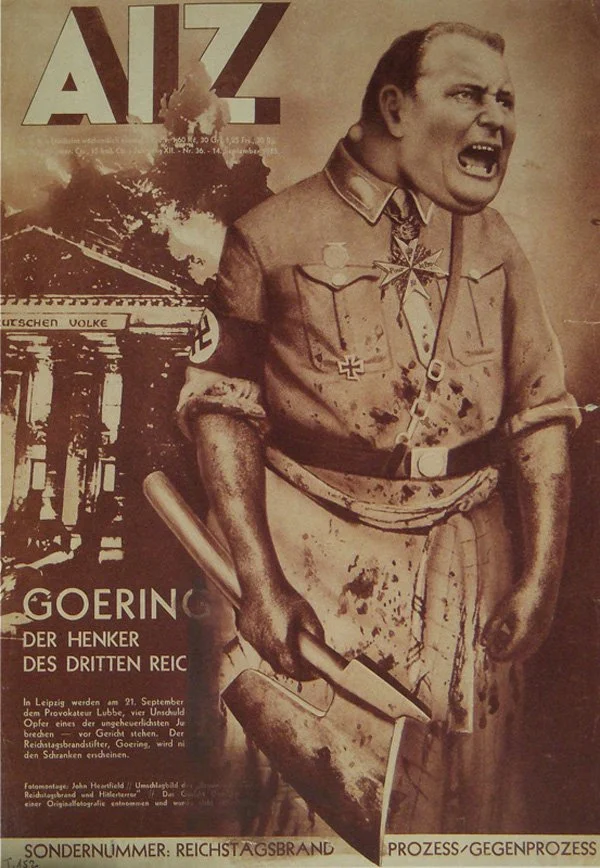
Goering: The Executioner of the Third Reich

There is also a contrast in tactility and randomness. Dada collages often looked obviously assembled, with jagged edges and mismatched fragments that were part of the aesthetic. The process of chance (dropping paper, etc.) was often left visible as part of the art’s meaning (embracing imperfection and accident). AI images, by design, aim for coherence, often photorealism or a seamlessly painted look, and to the point that artists who use those styles (that were stolen) will get witch-hunted. The “joins” of the collage are invisible; the output is meant to look like a single, unified image. Any randomness in the generation process is hidden in the final product (except when the AI makes mistakes, like giving a figure too many fingers). In short, Dada’s modality was material deconstruction, whereas AI’s modality is mathematical reconstruction.