Rainbow City: Exploding onto the Global Stage (2010–2012)
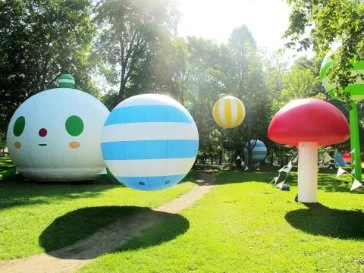
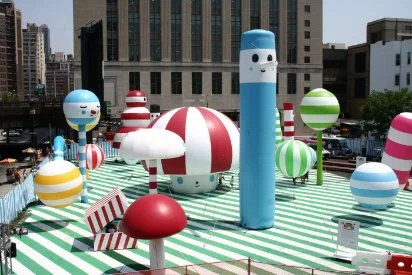
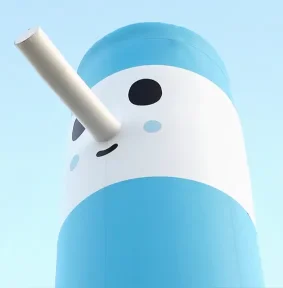
All the threads that FriendsWithYou had been weaving, such as interactive fun, spiritual symbolism, and pop culture aesthetics, it all came together spectacularly in “Rainbow City.” If Cloud City was a playground scaled to a gallery, Rainbow City was a playground scaled to a city block. This sprawling environmental installation consisted of some 40 air-filled sculptures ranging from 8 feet to 50 feet high. Debuting in June 2010 as a commission for Toronto's Luminato Festival (aptly under the banner “Wish Come True Festival”), Rainbow City was an instant hit. Imagine an open field transformed into a forest of balloon-like totems: striped cones, polka-dotted orbs, wavy tube-men, happy mushrooms. They’re all rendered in a minimalist, superflat style that nodded to cartoons and geometric abstraction at once. The color palette was pure candy: cherry reds, sunshine yellows, sky blues, bright greens. This was a landscape where line and shape were reduced to their most basic, joyous forms, a polka dot here, stripes over there... and where space itself became a sandbox for the public. Children ran between towering inflatables, adults bounced gently against soft walls, and everyone's inner child seemingly came alive for a moment of collective glee.
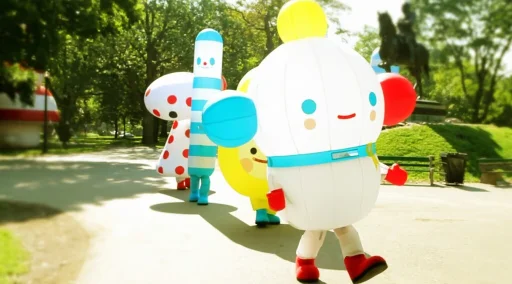
The installation's next stops only amplified its renown. In late 2010, Rainbow City landed at Art Basel Miami Beach, presented by Paper Magazine and pop star Pharrell Williams in collaboration with AOL. Pharrell (an early supporter of the duo's work) helped shine a spotlight on FriendsWithYou, framing Rainbow City as the place to be at the art fair. Some 20,000 people visited and frolicked among the bobbing sculptures. Then, in the summer of 2011, Rainbow City made its most high-profile appearance: filling 16,000 square feet of New York's new High Line Park as a public art celebration for the park's second phase opening. For many jaded New Yorkers, the sudden sight of enormous pastel balloons wobbling against the backdrop of Manhattan's brick buildings was utterly disarming. It was the collective's first large-scale installation in NYC, and it arrived with “relentless cheerfulness” by design.
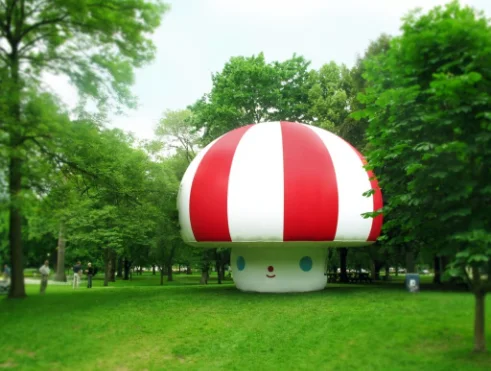
Yet Rainbow City was not mere spectacle; it was “created to allow the viewer to reinterpret spirituality,” the artists asserted. Each gigantic inflatable, they suggested, was like a modern totem, a self-reflective portrait onto which the viewer could project emotions. By simplifying faces to two eyes and a smile, and bodies to bold silhouettes, FriendsWithYou allowed people of any background or age to see themselves in the characters. “Visitors were encouraged to come and be in awe of these large, reduced shapes,” Arturo Sandoval III explained – the awe being the same kind one might feel in a cathedral, but here prompted by friendly cartoonish forms. Through play, an “almost religious scenario of connectivity” emerged, as one critic put it, turning bouncing in a bounce-house into a communal rite. Indeed, if you looked closely at Rainbow City on a summer day, you could see strangers laughing together as they squeezed past a wiggling pillar, or a parent and child lying on the grass contemplating a smiling blimp in the sky. These interactions were the true art of Rainbow City. It was a textbook case of what art theorists term participatory art or relational aesthetics, where the social engagement itself is the artwork. FriendsWithYou folded these avant-garde concepts into a package so accessible and kawaii (cute) that people didn't feel intimidated by “art,” they just jumped in and played.
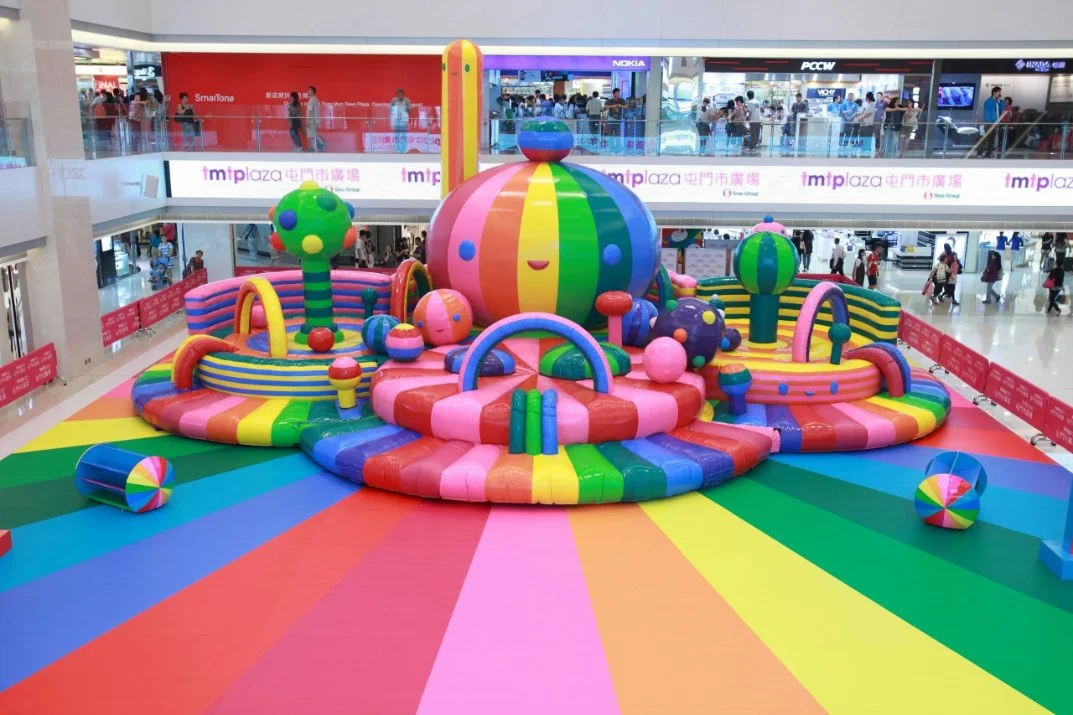
Other projects around this time cemented FriendsWithYou's international reach. In the summer of 2012, Hong Kong's Tuen Mun Town Plaza was host to “Happy Rainbow,” a 16-piece inflatable bounce-house installation that echoed Rainbow City's motifs. Happy Rainbow was fashioned as a modern shrine of joy. A “colorful interactive bounce house” integrated with fiberglass sculptures and translucent resin pieces. At 40 feet tall, it quite literally enveloped visitors in a multicolored glow, which the artists intended to “transcend them into a higher state of self-awareness.”. Even in bustling Hong Kong, thousands came to experience this pop-up sanctuary of play. The installation was described as being “charged with so much color and power that it brings great harmony to all who look upon it,” and local press noted how it blended elements of Eastern spiritual iconography with the universal language of fun. By now, comparisons were often drawn between FriendsWithYou and leading figures of contemporary art who also use bold colors and repetition to transformative effect. Critics called Borkson and Sandoval “progenies of Takashi Murakami and Yayoi Kusama,” acknowledging how, like Murakami, they employ a “superflat” pop aesthetic, and like Kusama, they create enveloping environments of polka-dots and smiles. Indeed, in Rainbow City and Happy Rainbow, one could see Murakami's influence in the slick, graphic simplification of forms and the blur between high art and pop culture. Likewise, Kusama's legacy was felt in the way these installations offered a serene surrender to color and pattern – though instead of Kusama's infinite polka dots aiming for cosmic oneness, FriendsWithYou offered squishy clouds and rainbow roads aiming for childlike giddiness.
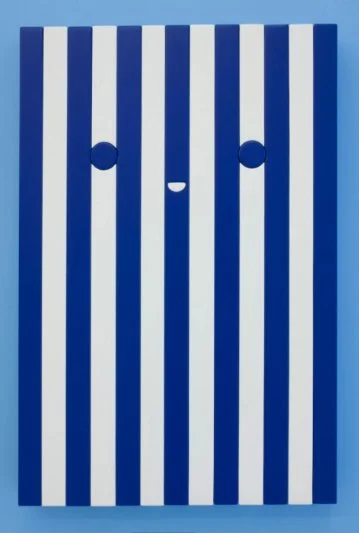
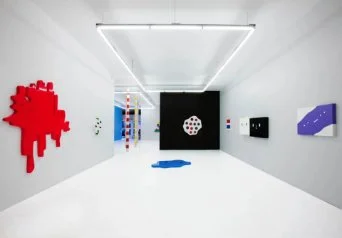
Amid these large public works, FriendsWithYou didn't neglect the art gallery scene. In 2011, they mounted “:)” (yes, a smiley face title), their first solo show in New York, at The Hole gallery. The exhibition featured 22 artworks, including cheerful geometric figures sculpted from wood and painted with glossy car-paint finishes. Critics noted how these pieces distilled the same positive energy of the inflatables into static art objects. The show was dubbed “an interactive, experiential wonderland of pop-straction” and “relentlessly cheerful.” In one corner, visitors might find a cluster of colorful, round-headed sculptures resembling a family of friendly aliens; in another, paintings of smiling clouds floating on fields of flat color. Much like Murakami's or Kusama's exhibitions, :) at The Hole demonstrated that even within a white-cube gallery, FriendsWithYou could create an ambiance of playful spirituality. The artists themselves saw these works as part of a “service art” movement, art in service of the people. They deliberately stripped away any pretension, aiming to communicate on a direct, emotional level. “FWY feels art is for everyone and can aid in connecting humankind,” they stated in the show notes. In an art capital like New York, this ethos was almost radical: while many artists concerned themselves with critique or complexity, FriendsWithYou unabashedly offered happiness and friendship as their artistic message.