… / / Outcomes and Future Trajectories: Lessons from Dada for AI Art
katsumimaki.com
General
  • Home
  • About
  • Start Here
Topics
  • Newsletters
    • Fanmade
      • Anti Group Tendencies
        • Page 1
        • Life as an “Anti-Group”
        • Afterword
      • Burnout
        • Page 1
        • Afterword
      • Empathy
        • Page 1
        • Afterword
      • Friendswithyou
        • Origins in Miami: Seeds of a Playful Universe (2002–2004)
        • Building a World of Play: Interactive Installations (2005–2009)
        • Rainbow City: Exploding onto the Global Stage (2010–2012)
        • Animism, Art, and “Happy Virus”: A Philosophy of Play
        • Collaborations and Pop Culture Crossovers (2013–2017)
        • Post-Internet Explorations: From Virtual Worlds to NFTs (2015–2022)
        • Conclusion: Pop Spiritualists in a Connected Era
      • From Dada Collages To Ai Art
        • Introduction and Personal Motivation
        • Dadaism: Collage and the Original “Anti-Art” Movement
        • AI-Generated Art: Algorithms as the New Collage
        • Comparing Dadaism and “AI-Artism”
        • Modality and Technique: Collage vs. Computation
        • Origins and Intentions: Art Movement vs. Tech Innovation
        • Reception and Cultural Impact: Anti-Art Manifesto vs. Existential Disruption
        • Outcomes and Future Trajectories: Lessons from Dada for AI Art
        • Conclusion: Art, AI, and Accessibility – A Personal Reflection
      • Lights Sound Printing
        • Page 1
        • Lighting: High Color Fidelity vs. Spectral Restriction
        • Audio: Theatre Mic Techniques for a Hybrid D&D Game
        • Digital Fabrication: From Desktop 3D Printing to Stage-Size Scenery
        • Conclusion: Personal Reflections on Tech in Theatre
      • Littlespaces
        • Overalls and Feeling Small
        • Voluntary vs. Involuntary Age Regression
        • Stress, Comfort, and Little Space
        • Age Regression vs. Age Play
        • The ABDL Identity and Spectrum
        • Community Norms, Safety, and Stigma
        • Unpacking Misconceptions
        • Afterword
      • Monoline
        • Origins, Purpose, and Brief History
        • Shel Silverstein’s Expressive Monoline Style
        • From Viral Outlines to Indie Cartoons: Monoline’s Digital Revival
        • Bridging Traditional and Digital: Community Art and Personal Practice
        • The Commercial and Algorithmic Appeal of Monoline
        • Communities and Culture: Constraints as a Creative Identity
        • Conclusion and Personal Reflections
        • Afterword
      • Never Have I Ever: Kinks
        • About Me
        • Aromantic Asexual Autonomy
        • A Space for Kink Exploration: Trials in Tainted Space
        • Consent and Customization in a Kinky Universe
        • From Kink Exploration to Relational Ethics
        • Doe Steele: The Trials in Tainted Space
        • Opening Up on Mhen’ga: Amber Changes the Game
        • Crew as Community
        • Relationship Anarchy Among the Stars
        • Afterword
      • Ps1lowpoly
        • Page 1
        • Early Low-Poly 3D: Console Limitations Shaping an Aesthetic
        • From Quirk to Art Form: Low-Poly Revival and Nostalgia
        • Modern Low-Poly in Contemporary Media and Art
        • Super Mario 64
        • Indie Animators and Series
        • Comedy Skits and Memes
        • Cozy vs. Creepy
        • Interview with an Appreciator
        • Conclusion
        • Afterword Fave (Interviewee)
      • Saved My Life
        • My Relationship With Food
        • My Trip to the Hospital
        • What My Journey Looks Like Now
        • Re-Learning My Purpose
        • Afterword
      • Slowart
        • Additive
        • Subtractive (Decay)
        • Performative
        • Slow-Change (Growth)
        • Latent Activation
        • Pilgrimage
        • Witnessing
        • Conclusion: Embracing the Art of Slow Moments
      • The Life Death And Afterlife Of Mannequins
        • I. The Enduring Allure of Mannequins
        • II. The Material and Historical Trajectory of Mannequins
        • Evolution from Functional Forms to Lifelike Figures
        • The Fiberglass Revolution: Durability and Mass Production
        • III. Mannequins as Cultural Artifacts: From Discarded to Desired
        • The Paradox of Invisibility and Persistent Presence
        • Sustainable Second Lives: The Mannequin Madness Model (Judi Henderson)
        • Table 2: Case Studies of Mannequin Reuse
        • The Uncanny Valley: Mannakin Hall as Experiential Art (Roz Edwards)
        • IV. Mannequins in the Human Imagination: Companionship and Projection
        • V. Reflections on Mannequin Endurance: A Personal Synthesis
      • Valentine
        • Page 1
        • A Sweet Gesture After Lockdown
        • Yearning vs. Attraction
        • Thought Experiments with a Safety Net
        • The Fun of Shipping (Even for the Aro-Ace Crowd)
        • Conclusion: Choose Your Own Valentine
    • Original
      • 2024-09 September
      • 2024-10 October
      • 2024-11 November
      • 2024-12 December
      • 2025-01 January
      • 2025-02 February
      • 2025-03 March
      • 2025-04 April
      • 2025-05 May
      • 2025-06 June
      • 2025-07 July
      • 2025-08 August
      • 2025-10 October
      • 2025-11 November
      • 2025-12 December
      • 2026-01 January
      • 2026-02 February
      • 2026-03 March
  • Stories
    • Fanmade
      • Daggerheart
        • CiCi
          • Page 1
          • Page 2
      • Dnd
        • Azurion Nightfall
          • Page 1
        • Little
          • Page 1
      • History
        • Prahlada and Malala
          • Page 1
          • Page 2
          • Page 3
          • Page 4
          • Page 5
          • Page 6
          • Page 7
          • Page 8
          • Page 9
          • Page 10
      • My Little Pony
        • Stellar Redux
          • Page 1
          • Page 2
          • Page 3
          • Page 4
      • Pathfinder
        • Occupation on Vesk 3
          • Page 1
          • Page 2
          • Page 3
          • Page 4
      • Satisfactory
        • Everroot
          • Page 1
        • Reaper and ADA
          • Chapter 1
          • Chapter 2
          • Chapter 3
          • Chapter 4
          • Chapter 5
          • Chapter 6
          • Chapter 7
          • Chapter 8
      • Star Trek
        • USS Mesa
          • Page 1
          • Page 2
          • Page 3
      • Star Wars
        • Protocols and Princesses
          • Page 1
        • Shakka'Dira
          • Page 1
          • Page 2
          • Page 3
          • Page 4
          • Page 5
          • Page 6
          • Page 7
          • Page 8
          • Page 9
      • Trolls
        • Rave and Relaxation
          • Page 1
    • Original
      • Neon Fairy Lights
        • Main Story
          • Page 1
          • Page 2
          • Page 3
          • Page 4
          • Page 5
          • Page 6
          • Page 7
          • Page 8
          • Page 9
          • Page 10
          • Page 11
          • Page 12
          • Page 13
          • Page 14
          • Page 15
      • Northern Lights
        • Main Story
          • Page 1
          • Page 2
          • Page 3
          • Page 4
          • Page 5
          • Page 6
      • Virtual World
        • Commands
          • 01 Bash
          • 02 Cat
          • 03 Ping
          • 04 Mint
          • 05 Vi
          • 06 Echo
          • 07 Dig
          • 08 Tar
          • 09 Sudo
          • 10 Kali
          • 11 Nano
          • 12 RPM
          • 13 Tail
          • 14 Grep
          • 15 Cron
          • 16 Alma
          • 17 Shell
          • 18 Yaml
          • 19 Sed
          • 20 Curl
        • Five Stories
          • 01 Cautious 01
          • 02 Desperate 01
          • 03 Fading 01
          • 04 Cautious 02
          • 05 Indifferent 01
          • 06 Gentle 01
          • 07 Cautious 03
          • 08 Desperate 02
          • 09 Fading 02
          • 10 Cautious 04
          • 11 Indifferent 02
          • 12 Gentle 02
          • 13 Cautious 05
          • 14 Desperate 03
          • 15 Fading 03
          • 16 Cautious 06
          • 17 Indifferent 03
          • 18 Gentle 03
          • 19 Cautious 07
          • 20 Desperate 04
          • 21 Fading 04
          • 22 Cautious 08
          • 23 Indifferent 04
          • 24 Gentle 04
          • 25 Cautious 09
          • 26 Desperate 05
          • 27 Fading 05
          • 28 Cautious 10
          • 29 Indifferent 05
          • 30 Gentle 05
          • 31 Cautious 11
          • 32 Desperate 06
          • 33 Fading 06
          • 34 Cautious 12
          • 35 Indifferent 06
          • 36 Gentle 06
        • Main Story
          • Page 1
          • Page 2
          • Page 3
          • Page 4
          • Page 5
          • Page 6
          • Page 7

Outcomes and Future Trajectories: Lessons from Dada for AI Art

History provides some clues about how radical art movements play out. The Dada movement, while short-lived in pure form, had lasting outcomes. Many Dadaists became influential in other movements (Surrealism, for example, took Dada’s love of chance and the unconscious in a new direction). Over time, the shock of Dada wore off, and what was once anti-art became part of the vocabulary of art. Museums today proudly display Duchamp’s Fountain (replicas of it, since the original was lost) as a masterpiece. What was once scandalous is now a treasured piece of art history. Indeed, Fountain was named by some surveys as the most influential artwork of the 20th century. Dada’s anti-art stance, ironically, ended up expanding art rather than destroying it. By the 1960s, artists like Andy Warhol (with his Brillo Boxes and soup cans) followed a Duchampian line of thought, and the idea that art can appropriate commercial or everyday imagery was commonplace. In other words, the outcome of Dada was a paradigm shift: it didn’t end art; it changed art. It democratized the materials of art (anything could be art) and put new emphasis on concept over execution.

If history were to repeat itself in parallel, one might predict that AI art will likewise become an accepted part of the art landscape in time. The controversies of today may settle as new norms develop. For instance, there might be standards for transparency (artworks might disclose if AI was used), or new genres recognized (“AI-assisted art” becomes a category of its own). We already see prestigious art venues cautiously engaging with AI art: there have been gallery shows and museum exhibits of AI-generated works, and auction houses like Christie’s have sold AI art pieces for substantial sums. This suggests that, despite resistance, the art market is beginning to treat AI art as real art.

realcartoon3d_v12.safetensors Entity V1 - my prompt was experimental with negative/excessive weights, Conflicting concepts, and loras.

However, there are also differences in the outcomes due to the differing natures of Dada and AI art. One key difference is speed and scale. Dada took years to make its influence felt and decades to be fully absorbed; AI art’s spread is happening in a matter of months or a few years. This compressed timescale means the art world and society might have trouble adapting gracefully. There is an ongoing scramble in legal systems to address AI’s impact (for example, cases about whether AI-generated images can be copyrighted, or lawsuits as mentioned regarding training data). Dada didn’t really pose a legal threat to anyone’s livelihood, whereas AI art at scale potentially does impact illustrators, stock photographers, etc., by automating part of their work. That could lead to a more contentious integration into the art world, with possibly some regulatory intervention (e.g., requiring opt-in for training data, or labeling AI content).

Another outcome to consider is how far the technology will go. Dada had a relatively contained scope (visual art, literature, performance). AI generative models, on the other hand, are rapidly advancing and spreading into multiple modalities. Already, we have text-to-video models emerging. There are AI systems for music composition and voice cloning as well, which have led to things like “new” songs featuring vocals of long-deceased or unwilling artists. This means “AI art” is not stopping at static images – it’s moving into animation, film, music, even writing. The convergence of these could fundamentally change creative industries. We might imagine a future where an individual can generate an entire short film (visuals, soundtrack, script) by describing it to an AI. This goes beyond what Dada ever encompassed. The social implications (both exciting and concerning) are vast. On the positive side, it could mean an explosion of creativity and accessible content creation (everyone becomes a creator, not just a consumer). On the negative side, it might flood the world with derivative, machine-made content and further blur authorship (if a film is AI-made, who is the filmmaker?).
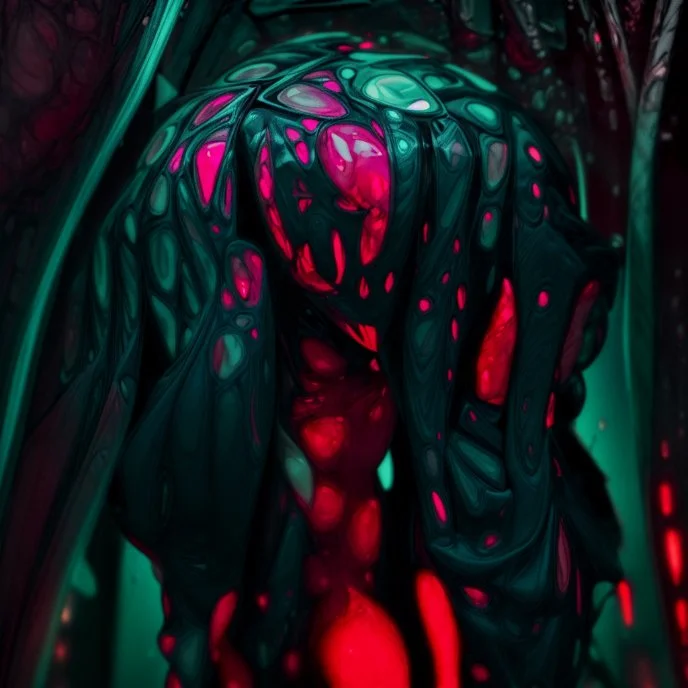
If we draw a historical analogy: after Dada and Surrealism, art didn’t collapse; it branched into new forms and often returned to older ones, like how Abstract Expressionism revived the artist’s gesture that Dada had rejected. With AI, we may see a similar hybrid future, where artists use it not as a replacement but as a tool, much like photographers embraced Photoshop. In my own work with Stable Diffusion, I push prompt weights beyond their intended range and combine contradictory concepts (like asking it to generate “wet” and “dry” at the same time) to force the model into producing unintelligible and unexpected results. Prompt weights especially break LoRAs (Low-Rank Adaptations, which are mini fine-tunes for specific styles or subjects), pushing them far outside their designed use cases to generate unstable but expressive outcomes.
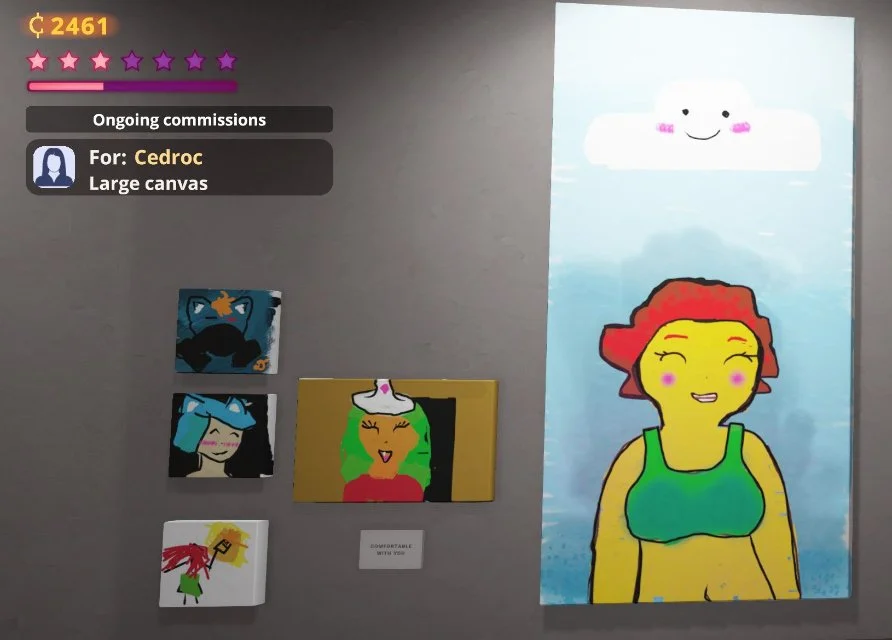
SuchArt - some of my commissions, placed in my virtual gallery (which is a virtual reality game Within the actual game, of course)

I wouldn’t be surprised if we see an “Anti-AI Art” movement, where artists push back by sticking to traditional, human-only methods. I’ve been playing SuchArt: Genius Artist Simulator, and it captures this idea in a fun, creative way. The game is set in a quirky, post-human future where AI has taken over the art world, and human artists are rare. It reflects the tension between technology and creativity, but with humor and charm. I love how it lets me take silly commissions, mess around with paint physics, and customize my space – all while playfully exploring what it means to be a “real” artist in a world run by machines.

The result of all this might not be a total shift in one direction or another, but a reshaped art world. I envision one that includes AI-generated work but also gives renewed value to human-made art. In this new landscape, the story behind the work (its authorship, intention, process) may matter more than ever. But then again, if you see a photo that moves you just by looking at it, then who’s to dictate how you respond or value it for yourself?

One thing seems certain: AI art is not going away. The technology is improving, and public interest is high. Unlike Dada, which was a rebellion that dissipated once its point was made, AI art is tied to a broader technological transformation that is still accelerating. The fact that AI art is expanding into video, music, and beyond suggests its impact will actually grow. It’s conceivable that in a decade, “generative media” will be as commonplace as photography or CGI is today. At that point, our current debates might sound quaint. Just as we no longer debate if a photograph is art (we accept that it can be, depending on context and intent), future audiences may accept AI creations and judge them by their imaginative quality or emotional impact rather than by their provenance.

That said, the differences in populace and intention we discussed will likely modify the outcomes. Because AI art is not a unified artistic movement with a philosophy, it may not leave a coherent artistic legacy in the way Dada did (with manifestos and identifiable style). Instead, AI art’s legacy might be more about tools and capabilities integrated into many art forms. In other words, rather than “AI Art” being an art movement, we might see all art fields incorporating AI to some degree (just as digital tools are now everywhere in art). Heck, our digital art tools are getting so much better at emulating traditional art styles! The risk, some fear, is a homogenization of style – if everyone uses the same few algorithms, will art become more samey? But human creativity tends to find differentiation; perhaps artists will train custom AI models or use the tools in idiosyncratic ways to maintain a unique voice.

Another potential outcome is societal adaptation in terms of how we value creativity. The Dadaists posed the provocative idea that art can be meaningless or random, and yet still art. Society eventually accepted art that is conceptual or absurd. AI prompts a provocative idea that art can be made without human hand or conscious imagination, and we will have to decide if (or under what conditions) we accept that as “real art.” My hypothesis, taking the long view, is that history will rhyme: AI-assisted art will gain acceptance, but with new distinctions. Just as after photography’s arrival we distinguished between painting and photograph (but both are art), we may distinguish between human-crafted and AI-generated art, yet acknowledge both as valid categories. The outcomes will be modified by the differences. For example, new laws might govern AI’s use, and new economic models might arise (such as compensating original artists whose work trained the AIs, or emphasizing the human touch as a selling point in art).

Ultimately, if Dada taught us that art is a concept that can stretch, AI art is stretching it further. Dada ended up reinforcing the idea that art is about ideas and impact more than about traditional skill. AI art is reinforcing the idea that the process of creation can be fundamentally new – art can be co-created with autonomous systems (for certain definitions of art). The story is still unfolding, but looking back at Dada’s arc gives some optimism that what initially seems chaotic and threatening can lead to a richer, more inclusive understanding of creativity.