AI-Generated Art: Algorithms as the New Collage
How Generative Art Algorithms Work: Fast-forward a century from Dada, and we find a very different kind of art revolution underway: the rise of AI-generated art. Rather than political turmoil, this movement is fueled by technological advances in machine learning. Popular text-to-image AI models, such as Stable Diffusion, Midjourney, and DALL·E, have made it possible for anyone to create vivid images by simply typing a description. Under the hood, these systems are powered by deep neural networks trained on massive datasets of images. In essence, the AI has “seen” millions (or even billions) of pictures and learned statistical patterns from them. The model does not copy these images outright; instead, it learns a complex mathematical representation of the visual world. One can think of the trained model as a vast map of how pixels relate to each other to form meaningful features (like shapes, textures, or faces) across all the art and photos it was trained on. In technical terms, models like Stable Diffusion are latent diffusion models, a type of deep generative neural network. Stable Diffusion, released in 2022, introduced a breakthrough by making such image generation accessible to the public (the code and model weights were open-sourced). It consists of several parts: a variational autoencoder that compresses images into a smaller latent space, a U-Net neural network that performs iterative refinement (denoising), and a text encoder (from a model called CLIP) that allows images to be guided by natural language prompts.
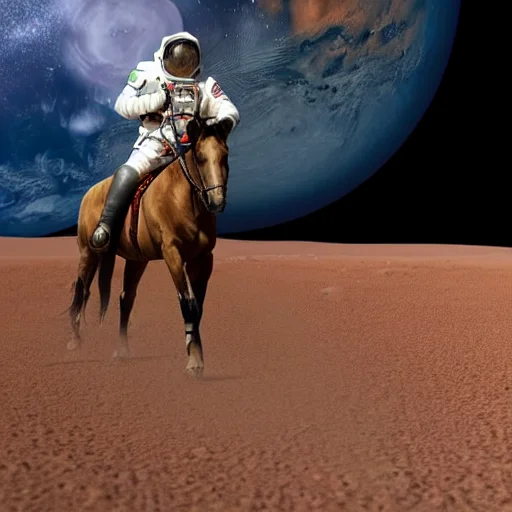
When you input a prompt – say, “a photograph of an astronaut riding a horse on Mars,” the model starts with a canvas of random noise and gradually denoises it into a coherent image that matches the prompt. During training, the model learned to reverse the process of image destruction: it was trained on examples of images being progressively noised, and it learned to predict and undo that noise step by step. At generation time, the AI essentially performs a kind of high-tech magic trick: it guesses a rough image, checks how it aligns with the text prompt via the CLIP text embeddings, and refines the image repeatedly after dozens or hundreds of tiny denoising steps. Each step is guided by what the AI “knows” a horse, astronaut, Mars, etc., should look like. Afterwards, a clear image emerges. The result might be an astronaut on a horse that looks surprisingly plausible, as if painted or photographed, even though this exact image has never existed before. All of this is done by calculations over arrays of numbers. The neural network’s convolutional layers use learned filters (kernels) that detect patterns (edges, shapes, color gradients) in the noise and reinforce those that match the prompt, much like a human sketching and refining details, but in a wholly mathematical way. The “knowledge” the AI draws on is encoded in millions of numeric parameters that were adjusted during training, effectively imprinting the statistics of the training images into the model.
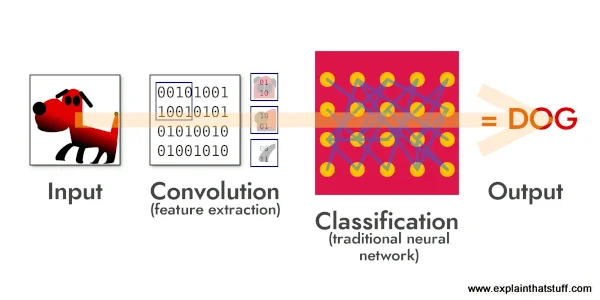
A modern Stable Diffusion model can generate an image for a text prompt (e.g. “a photograph of an astronaut riding a horse”) by iteratively refining random noise into a coherent picture. The AI has learned visual patterns from millions of training images, allowing it to synthesize novel images that resemble the art it has seen.
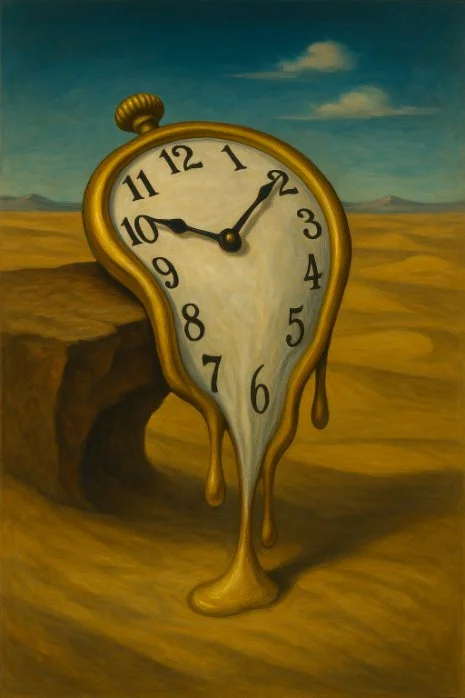
Because these AI models are trained on enormous datasets (for example, Stable Diffusion was trained on a subset of LAION-5B, a dataset of 5 billion image-text pairs scraped from the internet), they effectively capture a broad swath of art history and styles within them. A blog post that I came across described AI-generated images as “probabilistic art” (essay). What the AI produces is essentially an “average” of all the imagery it has ingested, tuned to the user’s prompt. If I ask for “a surrealistic painting of a melting clock in a desert”, the AI will conjure something that looks like a blend of many Dalí-esque paintings it has statistically internalized. The output may be unique, but it is fundamentally assembled from familiar elements; as Mathias Jansson from the blog puts it, an AI creates “a statistical model” of a surrealistic painting rather than a singular, conscious work. In a very real way, generative AI art is collage-like. Instead of physically cutting and pasting pieces of printed images, the AI is recombining tiny facets of what it “learned” from many images into a new whole. When you write a prompt, you do not get a unique image but a collage of average images of how previous artists and creators have interpreted the different parts of your prompt. Just as the Dadaists loved collage and remixing of existing media, AI art can be seen as the ultimate extension of remix culture: a cut-and-paste of everything digital that came before, performed by an algorithm. However, unlike a manual collage, this process is opaque and encoded in high-dimensional vectors. No human directly chooses which pieces of source images to combine; the machine’s complex statistical process does it automatically. In summary, AI image generators use mathematical models to generate art, learning from a vast corpus of existing art. They produce images via algorithmic procedures (diffusion or neural network sampling) that, conceptually, assemble visual elements much like a collage, though on a pixel-by-pixel basis guided by probabilities rather than by a human hand.
Reception: Controversy and “Anti-Art” Debate: The advent of AI-generated art has triggered intense debate in the art world and beyond. A central question is: if it wasn’t created by a human artist, is it still art? Some argue that AI art is a new medium and a tool that artists can use, much as photography or digital painting were new tools in their times. Others, especially many illustrators and graphic artists, have been openly hostile to AI image generators. A common criticism is that pressing a button to get an image lacks the creative process that defines art. Award-winning illustrator Rob Biddulph stated that AI-generated art “is the exact opposite of what I believe art to be. [...] True art is about the creative process much more than it’s about the final piece. And simply pressing a button to generate an image is not a creative process.” In his view, art requires a human expressing an internal feeling or vision, whereas an AI image is generated by an impersonal process without intention or emotion. This sentiment – “it’s the opposite of art” – notably echoes the idea of anti-art, albeit in a different sense than Dada. Here the term “opposite of art” is accusatory: critics see AI art as undermining artistry, rather than a conscious artistic rebellion. Interestingly, Dadaists embraced the “opposite of art” as a philosophy to expand art’s boundaries, whereas detractors of AI art use “opposite of art” to claim AI images are illegitimate and should not count as art at all.
Beyond philosophical qualms, there are ethical and legal controversies. AI models are trained on existing artworks (among other images) without permission from most of the original creators. Many artists feel that these models “steal” their style or even parts of their images. Indeed, the databases used (such as LAION-5B for Stable Diffusion) were compiled by scraping billions of images from the web indiscriminately. These include copyrighted works by countless artists. Thus, one hears the argument that an AI-generated image is effectively a derivative collage of stolen pieces. Some visual elements in AI outputs have even revealed remnants of source material (for example, distorted text that resembles watermarks or signatures from the training images). This has led to an artist-led backlash (e.g. the online campaign fNoToAIArt) and even lawsuits against AI companies for copyright infringement. In this sense, AI art has been received by parts of the art community as an existential threat – economically (potentially replacing jobs) and conceptually (challenging what it means to be an artist).
However, not everyone in art circles dismisses AI art. Some see it as a tool that can be guided by human creativity. They see it as a collaboration between artist and algorithm. For example, contemporary digital artists might use AI images as starting points (much as I do for sketching), then paint over or collage them further. Andrew Huang, who is a musician who likes to play with randomness in his idea generation process, commissioned an artist to make a “Book of Chances” card deck. The artist had always used a collage/Photoshop process with stock photos, but when the Book of Chances came out, there was an important discussion about AI art, and when it is used in a collage process. Andrew approached this discussion with a YouTube video full of nuance, deciding to donate all proceeds from the first batch of chance cards that incorporated AI “stock” photos (video). In the video, Andrew explained that “Scott chose to use AI, but if he hadn’t had access to it, he would have just kept on going with his usual process of manipulating stock images.” In short, he wouldn’t have tried to recreate an AI photo (that inspired him, for example) through more official means; he would simply change his idea for the collage.
There are also artists who write or train their own generative algorithms on their style, viewing the algorithm itself as their artistic creation, or assisting their artwork process with past examples of their art. The spectrum of reception is broad, but what’s clear is that AI art has ignited a discussion very reminiscent of earlier debates about new art forms. Just as people once asked “Photography isn’t real art, is it?” or reacted with outrage to Duchamp’s Fountain, we now hear “AI-generated images aren’t art – there’s no artist!” And just as Dada faced institutional rejection, AI art has been banned from some art communities and competitions (some contests have disqualified AI-made pieces, and major art portfolio sites like ArtStation saw protests until they agreed to allow artists to opt out of AI datasets). Nonetheless, AI art is rapidly proliferating among the public. Millions have experimented with apps and tools for generating images, enjoying the ability to create art without traditional skills. In a way, this democratization of image-making is the positive flipside: people who might never have created art (due to lack of ability, time, or training) now can visualize ideas and see them in seconds. This brings us to a critical comparison: whereas Dada’s anti-art was driven by artists with a philosophical agenda, the current wave of AI art is driven by technology and embraced largely by non-artists (programmers, hobbyists, everyday internet users). It wasn’t a coordinated art movement at its inception, but it is functioning as a disruptive force in art all the same.