… / / Slow-Change (Growth)
katsumimaki.com
General
  • Home
  • About
  • Start Here
Topics
  • Newsletters
    • Fanmade
      • Anti Group Tendencies
        • Page 1
        • Life as an “Anti-Group”
        • Afterword
      • Burnout
        • Page 1
        • Afterword
      • Empathy
        • Page 1
        • Afterword
      • Friendswithyou
        • Origins in Miami: Seeds of a Playful Universe (2002–2004)
        • Building a World of Play: Interactive Installations (2005–2009)
        • Rainbow City: Exploding onto the Global Stage (2010–2012)
        • Animism, Art, and “Happy Virus”: A Philosophy of Play
        • Collaborations and Pop Culture Crossovers (2013–2017)
        • Post-Internet Explorations: From Virtual Worlds to NFTs (2015–2022)
        • Conclusion: Pop Spiritualists in a Connected Era
      • From Dada Collages To Ai Art
        • Introduction and Personal Motivation
        • Dadaism: Collage and the Original “Anti-Art” Movement
        • AI-Generated Art: Algorithms as the New Collage
        • Comparing Dadaism and “AI-Artism”
        • Modality and Technique: Collage vs. Computation
        • Origins and Intentions: Art Movement vs. Tech Innovation
        • Reception and Cultural Impact: Anti-Art Manifesto vs. Existential Disruption
        • Outcomes and Future Trajectories: Lessons from Dada for AI Art
        • Conclusion: Art, AI, and Accessibility – A Personal Reflection
      • Lights Sound Printing
        • Page 1
        • Lighting: High Color Fidelity vs. Spectral Restriction
        • Audio: Theatre Mic Techniques for a Hybrid D&D Game
        • Digital Fabrication: From Desktop 3D Printing to Stage-Size Scenery
        • Conclusion: Personal Reflections on Tech in Theatre
      • Littlespaces
        • Overalls and Feeling Small
        • Voluntary vs. Involuntary Age Regression
        • Stress, Comfort, and Little Space
        • Age Regression vs. Age Play
        • The ABDL Identity and Spectrum
        • Community Norms, Safety, and Stigma
        • Unpacking Misconceptions
        • Afterword
      • Monoline
        • Origins, Purpose, and Brief History
        • Shel Silverstein’s Expressive Monoline Style
        • From Viral Outlines to Indie Cartoons: Monoline’s Digital Revival
        • Bridging Traditional and Digital: Community Art and Personal Practice
        • The Commercial and Algorithmic Appeal of Monoline
        • Communities and Culture: Constraints as a Creative Identity
        • Conclusion and Personal Reflections
        • Afterword
      • Never Have I Ever: Kinks
        • About Me
        • Aromantic Asexual Autonomy
        • A Space for Kink Exploration: Trials in Tainted Space
        • Consent and Customization in a Kinky Universe
        • From Kink Exploration to Relational Ethics
        • Doe Steele: The Trials in Tainted Space
        • Opening Up on Mhen’ga: Amber Changes the Game
        • Crew as Community
        • Relationship Anarchy Among the Stars
        • Afterword
      • Ps1lowpoly
        • Page 1
        • Early Low-Poly 3D: Console Limitations Shaping an Aesthetic
        • From Quirk to Art Form: Low-Poly Revival and Nostalgia
        • Modern Low-Poly in Contemporary Media and Art
        • Super Mario 64
        • Indie Animators and Series
        • Comedy Skits and Memes
        • Cozy vs. Creepy
        • Interview with an Appreciator
        • Conclusion
        • Afterword Fave (Interviewee)
      • Saved My Life
        • My Relationship With Food
        • My Trip to the Hospital
        • What My Journey Looks Like Now
        • Re-Learning My Purpose
        • Afterword
      • Slowart
        • Additive
        • Subtractive (Decay)
        • Performative
        • Slow-Change (Growth)
        • Latent Activation
        • Pilgrimage
        • Witnessing
        • Conclusion: Embracing the Art of Slow Moments
      • The Life Death And Afterlife Of Mannequins
        • I. The Enduring Allure of Mannequins
        • II. The Material and Historical Trajectory of Mannequins
        • Evolution from Functional Forms to Lifelike Figures
        • The Fiberglass Revolution: Durability and Mass Production
        • III. Mannequins as Cultural Artifacts: From Discarded to Desired
        • The Paradox of Invisibility and Persistent Presence
        • Sustainable Second Lives: The Mannequin Madness Model (Judi Henderson)
        • Table 2: Case Studies of Mannequin Reuse
        • The Uncanny Valley: Mannakin Hall as Experiential Art (Roz Edwards)
        • IV. Mannequins in the Human Imagination: Companionship and Projection
        • V. Reflections on Mannequin Endurance: A Personal Synthesis
      • Valentine
        • Page 1
        • A Sweet Gesture After Lockdown
        • Yearning vs. Attraction
        • Thought Experiments with a Safety Net
        • The Fun of Shipping (Even for the Aro-Ace Crowd)
        • Conclusion: Choose Your Own Valentine
    • Original
      • 2024-09 September
      • 2024-10 October
      • 2024-11 November
      • 2024-12 December
      • 2025-01 January
      • 2025-02 February
      • 2025-03 March
      • 2025-04 April
      • 2025-05 May
      • 2025-06 June
      • 2025-07 July
      • 2025-08 August
      • 2025-10 October
      • 2025-11 November
      • 2025-12 December
      • 2026-01 January
      • 2026-02 February
      • 2026-03 March
  • Stories
    • Fanmade
      • Daggerheart
        • CiCi
          • Page 1
          • Page 2
      • Dnd
        • Azurion Nightfall
          • Page 1
        • Little
          • Page 1
      • History
        • Prahlada and Malala
          • Page 1
          • Page 2
          • Page 3
          • Page 4
          • Page 5
          • Page 6
          • Page 7
          • Page 8
          • Page 9
          • Page 10
      • My Little Pony
        • Stellar Redux
          • Page 1
          • Page 2
          • Page 3
          • Page 4
      • Pathfinder
        • Occupation on Vesk 3
          • Page 1
          • Page 2
          • Page 3
          • Page 4
      • Satisfactory
        • Everroot
          • Page 1
        • Reaper and ADA
          • Chapter 1
          • Chapter 2
          • Chapter 3
          • Chapter 4
          • Chapter 5
          • Chapter 6
          • Chapter 7
          • Chapter 8
      • Star Trek
        • USS Mesa
          • Page 1
          • Page 2
          • Page 3
      • Star Wars
        • Protocols and Princesses
          • Page 1
        • Shakka'Dira
          • Page 1
          • Page 2
          • Page 3
          • Page 4
          • Page 5
          • Page 6
          • Page 7
          • Page 8
          • Page 9
      • Trolls
        • Rave and Relaxation
          • Page 1
    • Original
      • Neon Fairy Lights
        • Main Story
          • Page 1
          • Page 2
          • Page 3
          • Page 4
          • Page 5
          • Page 6
          • Page 7
          • Page 8
          • Page 9
          • Page 10
          • Page 11
          • Page 12
          • Page 13
          • Page 14
          • Page 15
      • Northern Lights
        • Main Story
          • Page 1
          • Page 2
          • Page 3
          • Page 4
          • Page 5
          • Page 6
      • Virtual World
        • Commands
          • 01 Bash
          • 02 Cat
          • 03 Ping
          • 04 Mint
          • 05 Vi
          • 06 Echo
          • 07 Dig
          • 08 Tar
          • 09 Sudo
          • 10 Kali
          • 11 Nano
          • 12 RPM
          • 13 Tail
          • 14 Grep
          • 15 Cron
          • 16 Alma
          • 17 Shell
          • 18 Yaml
          • 19 Sed
          • 20 Curl
        • Five Stories
          • 01 Cautious 01
          • 02 Desperate 01
          • 03 Fading 01
          • 04 Cautious 02
          • 05 Indifferent 01
          • 06 Gentle 01
          • 07 Cautious 03
          • 08 Desperate 02
          • 09 Fading 02
          • 10 Cautious 04
          • 11 Indifferent 02
          • 12 Gentle 02
          • 13 Cautious 05
          • 14 Desperate 03
          • 15 Fading 03
          • 16 Cautious 06
          • 17 Indifferent 03
          • 18 Gentle 03
          • 19 Cautious 07
          • 20 Desperate 04
          • 21 Fading 04
          • 22 Cautious 08
          • 23 Indifferent 04
          • 24 Gentle 04
          • 25 Cautious 09
          • 26 Desperate 05
          • 27 Fading 05
          • 28 Cautious 10
          • 29 Indifferent 05
          • 30 Gentle 05
          • 31 Cautious 11
          • 32 Desperate 06
          • 33 Fading 06
          • 34 Cautious 12
          • 35 Indifferent 06
          • 36 Gentle 06
        • Main Story
          • Page 1
          • Page 2
          • Page 3
          • Page 4
          • Page 5
          • Page 6
          • Page 7

Slow-Change (Growth)

Slow Art as Organic Growth. While the additive lens involves stacking new parts, the slow-change/growth lens is about living development: art that grows and transforms biologically or organically over time. Think of sculptors who use trees, plants, or other living materials as their medium, collaborating with nature’s pace of growth. This form of slow art often blurs the line between art and gardening, or art and ecology. Changes occur not because someone adds a piece each year (as in the additive lens), but because the art itself is alive and following its own life cycle (with some guidance from humans). The results can be wonderfully whimsical: a chair that has grown from a tree trunk, a fence woven from living branches, a building shaped by bending and grafting living trees. Slow-growth art celebrates patience in cultivation. It requires vision to imagine the final form and devotion to see it through seasons and years. In a world of immediate gratification, nurturing a living artwork over decades is a profound act of faith in the future.
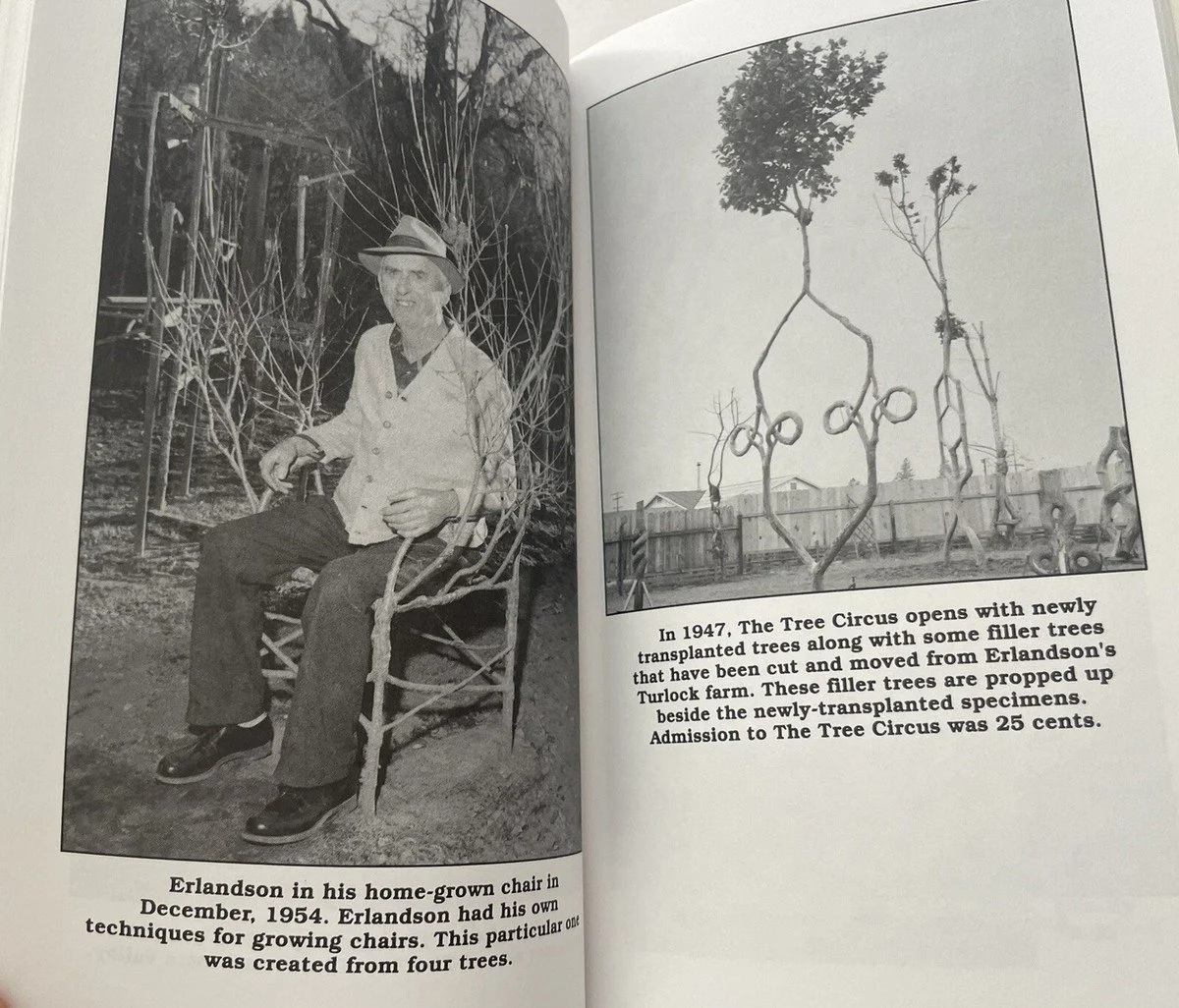
Arborsculpture (Living Tree Art): A spectacular example of slow-change art is the practice of arborsculpture – the art of shaping living trees into structures or sculptures. Rather than carving dead wood, arborsculptors guide trees as they grow, bending, pruning, and sometimes grafting branches so that multiple trunks fuse into designed patterns. It’s an ancient practice (there are hints of tree shaping going back to the 16th century), but it truly blossomed in the 20th century under a farmer-artist named Axel Erlandson. Erlandson was fascinated by the natural grafting he saw in trees and began experimenting. Over decades, he trained and twisted trees into surreal shapes: spiraling twins that merged into a lattice, loops and knots that looked like wooden pretzels, even a tree whose branches he cajoled into the shape of a lightning bolt. In 1947 he opened a roadside attraction in California called the “Tree Circus” to showcase over 70 of his living sculptures. Visitors gaped at these leafy wonders, living proof that art can quite literally grow. Modern arborsculptors have continued and expanded on this work. The very term arborsculpture was only coined in 1995 by Richard Reames and others, with a cheeky how-to manual titled How to Grow a Chair. And they meant it – growing furniture is indeed one application of this art. People have grown living chairs and tables by training tree limbs to curve and join. Others have more ambitious projects: in Germany, architect Ferdinand Ludwig has created “living architecture” (he calls it Baubotanik), including a three-story woven willow tower and a footbridge grown from trees. Imagine walking through a structure that is both building and forest, with trunks as pillars and branches slowly thickening as years go by. Another contemporary project, the Tree Circus’ spiritual successor, might be something like the “Pleaching” in the UK (where trees are grown into outdoor pavilions), or the famous “Living Root Bridges” of India (where villagers train aerial roots of fig trees across rivers, forming natural bridges over decades). All these examples share a common heartbeat: they take a long, long time. An arborsculptor must think in seasons and years, plotting where a supple young branch should be redirected now so that in ten years it forms the arm of a chair or the arch of a doorway. The art cannot be rushed – a sapling grows at its own pace, and you work with it slowly, coaxing, waiting, adjusting. The result is art that is never truly finished because the tree keeps growing, leaves bud and fall, new rings form inside the trunk. Arborsculpture is slow art that lives on nature’s clock, and it rewards those who come back periodically to see the incremental changes – the thickening of an entwined pattern or the way a once-disparate cluster of trunks has inosculated (fused) into one continuous form. It’s as if the artist and the tree are co-authors of a piece that writes itself over time. In a broader sense, arborsculpture highlights how growth itself is an artistic force. The patience, care, and foresight required are staggering, but the payoff is a living legacy: a green sculpture that might outlive the artist and continue to morph long after human hands have stepped back.
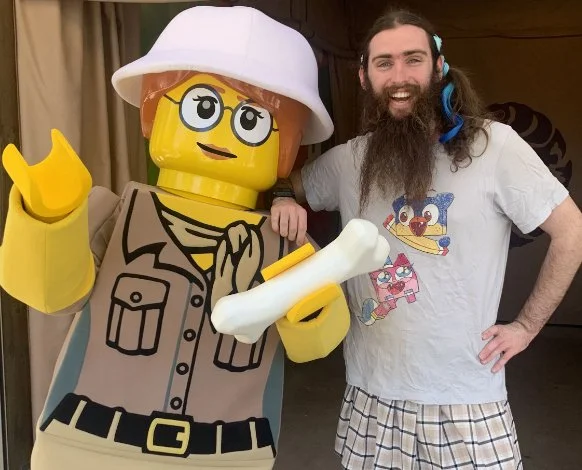
I didn’t know what to put here so this is a photo of me at Lego Land! I sometimes put colorful extensions in my pigtails, both of which have loose curls.

Six Years of Beard (A Personal Growth): My own foray into slow growth art is about hair! About six years ago, I made a personal vow: I would stop cutting my hair and beard and just let them grow, indefinitely. What began as a lazy pandemic experiment (“Let’s see what happens if I don’t shave,” I told myself) evolved into something deeper. Almost a spiritual commitment to witnessing change over time on my own body. As the months passed and stubble became scruff, then a bushy beard, then an unruly mane, I started to feel like both the gardener and the garden. There were awkward phases (oh, were there ever, the mustache stage where every sip of soup was an adventure, the hair-in-eyes stage where I looked like a sheepdog). But I resisted the urge to trim or tame. I treated it as a living sculpture, one where inaction was the creative act. My friends would remark with surprise every few months: “It’s even longer!” or joke that I was Jesus Christ. But beyond the laughs, something about the process felt meaningful to me. Each additional inch of hair was like a ring on a tree trunk, marking the passage of time. Committing to not cutting it meant embracing whatever form it took naturally – a lesson in accepting slow changes that are beyond my immediate control. It also became a conversation starter about patience and intention. People asked why I was doing it, and I found myself reflecting: it started as a simple experiment, but it became a statement of refusal to conform to the clean-cut norm and an homage to slow growth itself. I think of it like tending a bonsai or an arborsculpture but with my own follicles. I could comb it or oil it, maybe gently guide it (I sometimes braid the beard to keep it from flying about), but largely I let it be. Over six years, my appearance transformed dramatically. Old acquaintances barely recognize me now compared to photos when I was clean-shaven. There’s a sense of earned change here; I wear those years on my chin and in my pigtails. And much like a tree shaped over time, my beard has developed its quirks – a streak of orange here, a funny curl there, the one completely white hair – that make it uniquely “mine” and a record of time’s handiwork. This personal slow art project taught me that sometimes doing nothing (just allowing growth) can itself be an art form. It has been an exercise in patience, occasionally testing my resolve (well, the people giving unsolicited advice about cutting it really test my patience). Where in your life can you practice the art of slow growth? Perhaps you might nurture a plant from seed and watch it year by year, or even let a part of yourself grow gradually without constant intervention, whether that be your hair, your strength, or even your knowledge. What changes unfold if you simply give them the time and space to do so? The slow-change lens reminds us that growth has its own quiet magic if we have the patience to observe it.