… / / Digital Fabrication: From Desktop 3D Printing to Stage-Size Scenery
katsumimaki.com
General
  • Home
  • About
  • Start Here
Topics
  • Newsletters
    • Fanmade
      • Anti Group Tendencies
        • Page 1
        • Life as an “Anti-Group”
        • Afterword
      • Burnout
        • Page 1
        • Afterword
      • Empathy
        • Page 1
        • Afterword
      • Friendswithyou
        • Origins in Miami: Seeds of a Playful Universe (2002–2004)
        • Building a World of Play: Interactive Installations (2005–2009)
        • Rainbow City: Exploding onto the Global Stage (2010–2012)
        • Animism, Art, and “Happy Virus”: A Philosophy of Play
        • Collaborations and Pop Culture Crossovers (2013–2017)
        • Post-Internet Explorations: From Virtual Worlds to NFTs (2015–2022)
        • Conclusion: Pop Spiritualists in a Connected Era
      • From Dada Collages To Ai Art
        • Introduction and Personal Motivation
        • Dadaism: Collage and the Original “Anti-Art” Movement
        • AI-Generated Art: Algorithms as the New Collage
        • Comparing Dadaism and “AI-Artism”
        • Modality and Technique: Collage vs. Computation
        • Origins and Intentions: Art Movement vs. Tech Innovation
        • Reception and Cultural Impact: Anti-Art Manifesto vs. Existential Disruption
        • Outcomes and Future Trajectories: Lessons from Dada for AI Art
        • Conclusion: Art, AI, and Accessibility – A Personal Reflection
      • Lights Sound Printing
        • Page 1
        • Lighting: High Color Fidelity vs. Spectral Restriction
        • Audio: Theatre Mic Techniques for a Hybrid D&D Game
        • Digital Fabrication: From Desktop 3D Printing to Stage-Size Scenery
        • Conclusion: Personal Reflections on Tech in Theatre
      • Littlespaces
        • Overalls and Feeling Small
        • Voluntary vs. Involuntary Age Regression
        • Stress, Comfort, and Little Space
        • Age Regression vs. Age Play
        • The ABDL Identity and Spectrum
        • Community Norms, Safety, and Stigma
        • Unpacking Misconceptions
        • Afterword
      • Monoline
        • Origins, Purpose, and Brief History
        • Shel Silverstein’s Expressive Monoline Style
        • From Viral Outlines to Indie Cartoons: Monoline’s Digital Revival
        • Bridging Traditional and Digital: Community Art and Personal Practice
        • The Commercial and Algorithmic Appeal of Monoline
        • Communities and Culture: Constraints as a Creative Identity
        • Conclusion and Personal Reflections
        • Afterword
      • Never Have I Ever: Kinks
        • About Me
        • Aromantic Asexual Autonomy
        • A Space for Kink Exploration: Trials in Tainted Space
        • Consent and Customization in a Kinky Universe
        • From Kink Exploration to Relational Ethics
        • Doe Steele: The Trials in Tainted Space
        • Opening Up on Mhen’ga: Amber Changes the Game
        • Crew as Community
        • Relationship Anarchy Among the Stars
        • Afterword
      • Ps1lowpoly
        • Page 1
        • Early Low-Poly 3D: Console Limitations Shaping an Aesthetic
        • From Quirk to Art Form: Low-Poly Revival and Nostalgia
        • Modern Low-Poly in Contemporary Media and Art
        • Super Mario 64
        • Indie Animators and Series
        • Comedy Skits and Memes
        • Cozy vs. Creepy
        • Interview with an Appreciator
        • Conclusion
        • Afterword Fave (Interviewee)
      • Saved My Life
        • My Relationship With Food
        • My Trip to the Hospital
        • What My Journey Looks Like Now
        • Re-Learning My Purpose
        • Afterword
      • Slowart
        • Additive
        • Subtractive (Decay)
        • Performative
        • Slow-Change (Growth)
        • Latent Activation
        • Pilgrimage
        • Witnessing
        • Conclusion: Embracing the Art of Slow Moments
      • The Life Death And Afterlife Of Mannequins
        • I. The Enduring Allure of Mannequins
        • II. The Material and Historical Trajectory of Mannequins
        • Evolution from Functional Forms to Lifelike Figures
        • The Fiberglass Revolution: Durability and Mass Production
        • III. Mannequins as Cultural Artifacts: From Discarded to Desired
        • The Paradox of Invisibility and Persistent Presence
        • Sustainable Second Lives: The Mannequin Madness Model (Judi Henderson)
        • Table 2: Case Studies of Mannequin Reuse
        • The Uncanny Valley: Mannakin Hall as Experiential Art (Roz Edwards)
        • IV. Mannequins in the Human Imagination: Companionship and Projection
        • V. Reflections on Mannequin Endurance: A Personal Synthesis
      • Valentine
        • Page 1
        • A Sweet Gesture After Lockdown
        • Yearning vs. Attraction
        • Thought Experiments with a Safety Net
        • The Fun of Shipping (Even for the Aro-Ace Crowd)
        • Conclusion: Choose Your Own Valentine
    • Original
      • 2024-09 September
      • 2024-10 October
      • 2024-11 November
      • 2024-12 December
      • 2025-01 January
      • 2025-02 February
      • 2025-03 March
      • 2025-04 April
      • 2025-05 May
      • 2025-06 June
      • 2025-07 July
      • 2025-08 August
      • 2025-10 October
      • 2025-11 November
      • 2025-12 December
      • 2026-01 January
      • 2026-02 February
      • 2026-03 March
  • Stories
    • Fanmade
      • Daggerheart
        • CiCi
          • Page 1
          • Page 2
      • Dnd
        • Azurion Nightfall
          • Page 1
        • Little
          • Page 1
      • History
        • Prahlada and Malala
          • Page 1
          • Page 2
          • Page 3
          • Page 4
          • Page 5
          • Page 6
          • Page 7
          • Page 8
          • Page 9
          • Page 10
      • My Little Pony
        • Stellar Redux
          • Page 1
          • Page 2
          • Page 3
          • Page 4
      • Pathfinder
        • Occupation on Vesk 3
          • Page 1
          • Page 2
          • Page 3
          • Page 4
      • Satisfactory
        • Everroot
          • Page 1
        • Reaper and ADA
          • Chapter 1
          • Chapter 2
          • Chapter 3
          • Chapter 4
          • Chapter 5
          • Chapter 6
          • Chapter 7
          • Chapter 8
      • Star Trek
        • USS Mesa
          • Page 1
          • Page 2
          • Page 3
      • Star Wars
        • Protocols and Princesses
          • Page 1
        • Shakka'Dira
          • Page 1
          • Page 2
          • Page 3
          • Page 4
          • Page 5
          • Page 6
          • Page 7
          • Page 8
          • Page 9
      • Trolls
        • Rave and Relaxation
          • Page 1
    • Original
      • Neon Fairy Lights
        • Main Story
          • Page 1
          • Page 2
          • Page 3
          • Page 4
          • Page 5
          • Page 6
          • Page 7
          • Page 8
          • Page 9
          • Page 10
          • Page 11
          • Page 12
          • Page 13
          • Page 14
          • Page 15
      • Northern Lights
        • Main Story
          • Page 1
          • Page 2
          • Page 3
          • Page 4
          • Page 5
          • Page 6
      • Virtual World
        • Commands
          • 01 Bash
          • 02 Cat
          • 03 Ping
          • 04 Mint
          • 05 Vi
          • 06 Echo
          • 07 Dig
          • 08 Tar
          • 09 Sudo
          • 10 Kali
          • 11 Nano
          • 12 RPM
          • 13 Tail
          • 14 Grep
          • 15 Cron
          • 16 Alma
          • 17 Shell
          • 18 Yaml
          • 19 Sed
          • 20 Curl
        • Five Stories
          • 01 Cautious 01
          • 02 Desperate 01
          • 03 Fading 01
          • 04 Cautious 02
          • 05 Indifferent 01
          • 06 Gentle 01
          • 07 Cautious 03
          • 08 Desperate 02
          • 09 Fading 02
          • 10 Cautious 04
          • 11 Indifferent 02
          • 12 Gentle 02
          • 13 Cautious 05
          • 14 Desperate 03
          • 15 Fading 03
          • 16 Cautious 06
          • 17 Indifferent 03
          • 18 Gentle 03
          • 19 Cautious 07
          • 20 Desperate 04
          • 21 Fading 04
          • 22 Cautious 08
          • 23 Indifferent 04
          • 24 Gentle 04
          • 25 Cautious 09
          • 26 Desperate 05
          • 27 Fading 05
          • 28 Cautious 10
          • 29 Indifferent 05
          • 30 Gentle 05
          • 31 Cautious 11
          • 32 Desperate 06
          • 33 Fading 06
          • 34 Cautious 12
          • 35 Indifferent 06
          • 36 Gentle 06
        • Main Story
          • Page 1
          • Page 2
          • Page 3
          • Page 4
          • Page 5
          • Page 6
          • Page 7

Digital Fabrication: From Desktop 3D Printing to Stage-Size Scenery

The third area I explored is digital fabrication for theatre… Basically, how things are built! I have a personal stake in this: I own a Snapmaker U1 that can do 3D printing. I’ve used it to print multi-material gadgets and cosplay props. Naturally, I wondered: at an expo like USITT, which focuses on theatre technology, what role does 3D printing play? Are there companies showing off huge 3D printers that can create entire set pieces? Or is the focus more on CNC machines and other fabrication tools for scenery and props?

Walking through the thought experiment of the Expo floor, I identified at least one relevant exhibitor: ShopBot Tools (booth #715).

ShopBot is not a 3D printer maker; they make CNC routing machines that cut wood, plastics, foams, etc. And that actually answers part of my question: when it comes to large scenic pieces (like walls, columns, stage floors, giant letters, decorative panels), theatres often turn to CNC routing rather than 3D printing. On ShopBot’s site, I found a section about use cases in “Theatres & Museums”. It highlights that CNC technology has been embraced by theatres and exhibit designers worldwide. Many major regional theatres and universities have ShopBot CNCs in their scene shops. The reason is clear: a CNC can take a digital design and cut it out of plywood, MDF, acrylic, or foam very quickly and accurately. Need a perfectly shaped arch? Cut it out of foam with a CNC. Need 50 identical decorative patterns for a backdrop? CNC-cut them from thin plywood. And crucially, if your piece is bigger than the machine’s bed, you can slice the design into parts in CAD and then the CNC can cut those parts which you assemble like a puzzle. That means a 4’x8’ router can essentially produce an 8’x16’ wall by cutting it in sections. They mention modern CAM (computer-aided manufacturing) software can do this slicing and also nest parts efficiently to save material.

Reading that, I realized that my Snapmaker (which has a build volume of under a foot cubed) operates on the same principle in miniature as these scene shop CNCs do on the grand scale. I’ve printed small prop pieces in parts and glued them, where scenic shops cut big sets in parts and screwed them together. The scaling up is linear. Where I use grams of filament, they use sheets of plywood and blocks of foam.
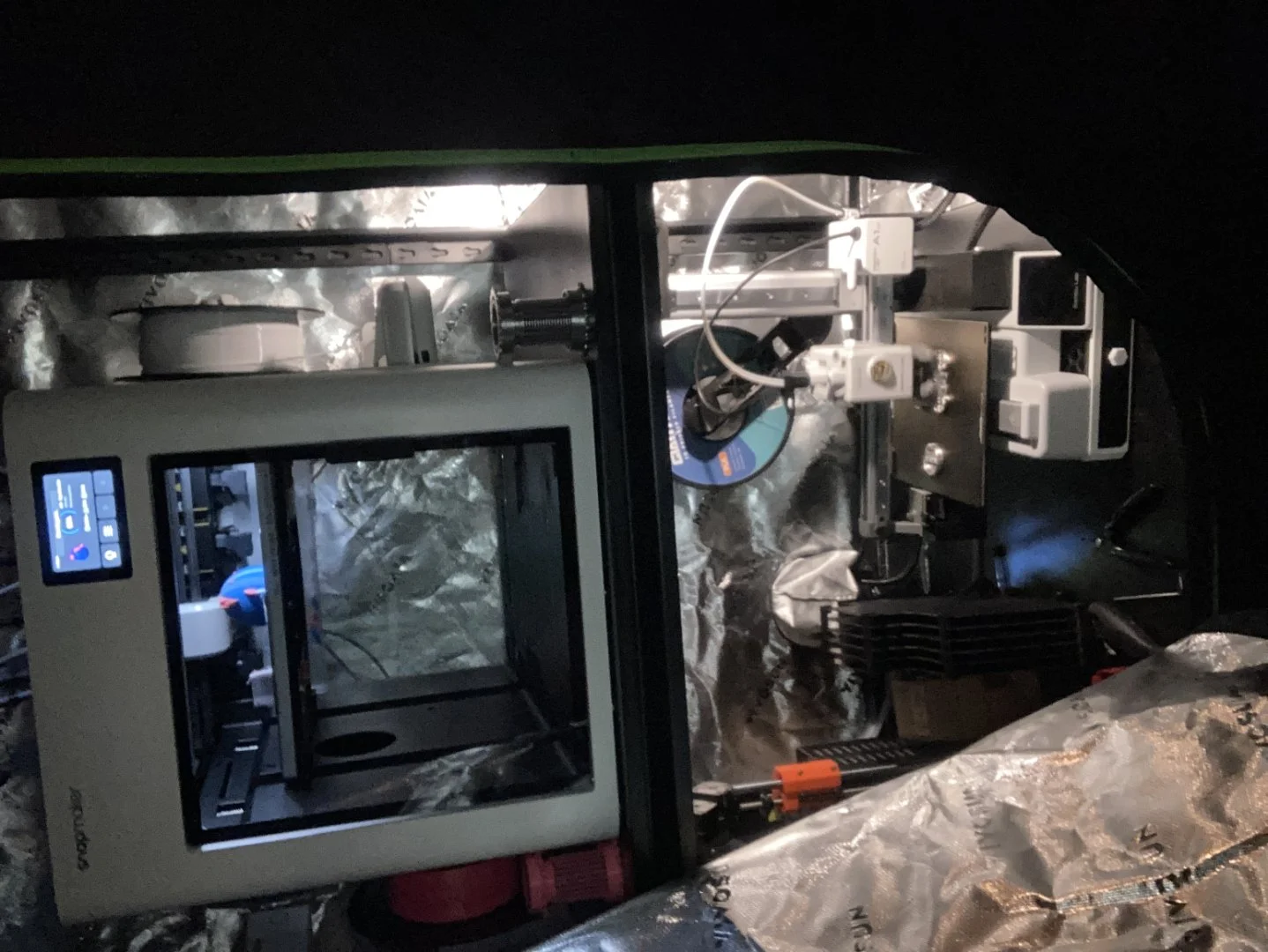
My printer setup, SnapMaker U1 and below it, BambuLabs A1 mini (and Prusa MK4s out of sight)

So, at USITT’s Stage Expo, I’m betting that while there might be a couple of 3D printer vendors or at least 3D printing demos (especially in the Props Lab sessions), the standout for big stuff would be companies like ShopBot (CNC routers), Epilog or Universal (laser cutters), maybe large-format printers for backdrops, etc. In fact, the USITT schedule showed a session in the Props Lab about “Building a Better Model Box Utilizing Laser Cutting & 3D Extrusion Technology”. That tells me they are actively teaching how to use 2D laser cutting and 3D printing for creating scale models or intricate props. The phrase “3D extrusion” is essentially a fancy term for FDM 3D printing… Extruding filament! So yes, 3D printing is definitely part of the modern props toolkit, and students at the conference were getting exposure to it. Another Props Lab blurb said “learn 2D and 3D prop techniques, from hand drafting and graphic design to upcycling, advanced upholstery, and thermoplastics”. Thermoplastics likely refers to materials like Worbla or vacuum-forming, but could also hint at things like 3D printed thermoplastic parts. At least, that’s what I think of when I hear thermoplastics (PLA, PETG, ABS and more).

From a practical standpoint for most theatres, 3D printing today is mostly used at a smaller scale. It could be used for props, prototype models, or occasionally to fabricate a complex part that would be too intricate to cut from flat material. For example, if a prop master needs a dozen ornate filigree brooches for costumes, they might 3D print them in resin rather than hand-sculpt each one. Or if they need a custom bracket to hold a piece of set in an odd way, they can print that in strong ABS or nylon. I found a forum where folks mentioned printing things like period telephones, weapon replicas, or architectural details for stage. So it’s definitely in use. I’ve 3d printed a medallion when I was too cheap (or just too creative) to buy SDSU’s graduation medallion. Then, I painted it gold and smiled, knowing I, among thousands of graduating students, had my little creative spin with a 3d printer that can make me anything my imagination is big enough for.