Consent and Customization in a Kinky Universe
TiTS is more than just a choose-your-own-adventure; it’s a build-your-own-adventure. The level of character customization and narrative flexibility it offers is astounding, and this is precisely what makes it such a fertile ground for both kink exploration and self-reflection. When you begin the game, you create your version of Captain Steele by choosing attributes like biological sex, physical features, and even subtle personality leanings. But unlike many games where your initial choices lock you in, TiTS treats identity as something malleable. Nearly every aspect of your character can be modified through in-game items or events. Want to explore life as a muscular amazon or a lithe androgynous goo person? There are transformative pills and technologies for that. Curious about what it’s like to have, say, feline ears and a tail, or to change your genital configuration? The game’s appearance system is highly granular, allowing transformations of nearly every body part, from the ordinary to the exotic. In my playthrough, I started Doe Steele off as a fairly baseline half-kaithrit (a cat-like humanoid species) with a few feline features, but over time I selectively modded her body to suit evolving narrative ideas. For instance, at one point I used a Xenogen Biotech item (Laquine Ears) to replace her cat ears with lop-eared bunny ears and gave her digitigrade bunny legs, simply because I became enamored with the idea of a cat-turned-rabbit hybrid roaming the stars. I left her with her original two cat tails (her heritage I wasn’t ready to part with) and kept her face human, again using save-scumming to make sure the random effects that the microsurgeon-laced ears I used would roll the dice in my favor. These changes weren’t just visual quirks; they became part of the story I was telling myself about Doe. Each transformation was an act of identity play. By altering Doe’s physiology, I was able to experiment with different facets of embodiment: How would navigating the world feel if I (through Doe) were more physically imposing? More overtly sexual in appearance? Entirely non-human? TiTS provided a safe sandbox for these questions, giving me a plethora of ways to alter attributes until I found a form that resonated with the themes I wanted to explore. And crucially, if I didn’t like a change, I could usually find (or purchase) another mod to change back, or simply reload a save to undo it. The reversibility of most transformations reinforced that sense of control: nothing was permanent unless I willed it so.
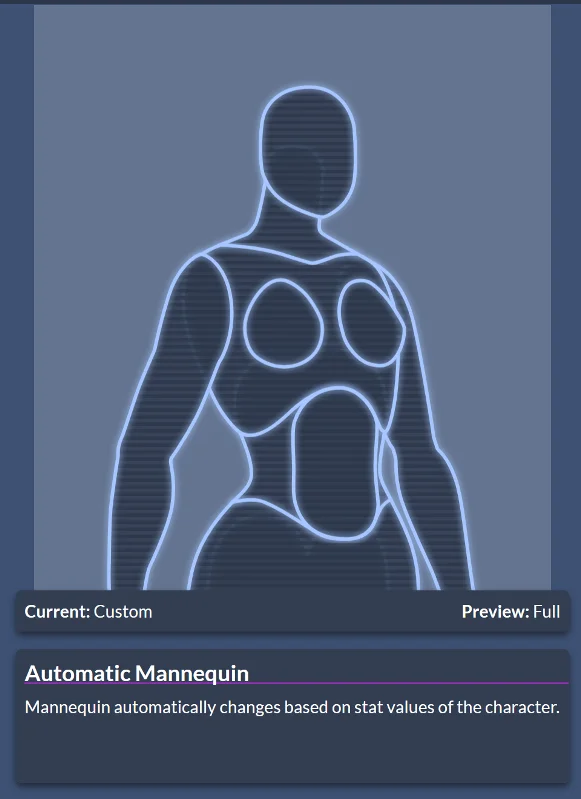
This deep customization is not just mechanical; it’s interwoven with the narrative (or more accurately, the dynamic text engine) that runs TiTS. The game’s content is extensively reactive to your character’s state. Writers have crafted scenes to accommodate a vast array of possibilities: the text will often acknowledge if Steele is, for example, visibly pregnant, or has multiple tails, or exudes a certain aura due to a perk or past decision. This means that the story you experience actively reflects the character you have built. In my case, when Doe eventually became pregnant (more on that shortly), the descriptive text would include nods to that; some potential partners even adjusted their behavior during scenes or unlocked dialog options, which made the world feel responsive and respectful of that big change. Likewise, Doe’s personality traits (the game tracks if one leans “nice” or “mischievous” or “hard” in demeanor) subtly influenced dialogue options and outcomes, reinforcing that who she was mattered to how the plot unfolded. The result of all this is an experience of unprecedented personalization. It’s not an exaggeration to say that no two players’ stories are exactly alike. The modular design ensures that my Doe Steele’s journey is uniquely mine. It ended up being a tailored narrative that rewards the specific choices and kinks I decide to pursue. In a way, the game functions like a collaborative storyteller, or a bespoke dungeon master, improvising descriptions and consequences that suit my playstyle. This goes beyond simple branching paths; it feels adaptive. TiTS’s use of a parser and modular scene system allows Fenoxo and his contributors to write scenes covering a vast combination of genders, anatomies, and choices, such that no two Steeles will see the scene worded exactly the same way. This reactivity is like a form of implicit consent within the narrative: the game “notices” what I’m doing with my character and adjusts to accommodate it, almost as if asking, “Is this what you want? If so, I’ll describe it in loving detail.” And the detail is certainly a spin of smut if I’ve ever seen one. Nothing feels stale or made haphazardly, the bar is set extremely high for the writing and is carried out across the entire adventure. I never feel at war with the narrative or frustrated by a mismatch between my intentions and the game’s response (though every time I’m pregnant, I avoid alcohol and some scenes haven’t been written in a way to accommodate that. But… Advanced microsurgeons can be an explanation to handwave it away).
To illustrate how this played out in practice, let me recount a pivotal arc in my playthrough: Doe Steele’s unexpected foray into parenthood. As a childfree person in real life, I never would have predicted that pregnancy would become one of my favorite parts of my in-game story. Initially, I steered clear of any choices that could lead to offspring; TiTS, in its expansive kink menu, does include pregnancy as a major theme (for those who are into that or wish to explore it), but I wanted to be intentional about it. I could simply buy Sterilex pills (an in-game contraceptive) and still participate in scenes that lead the story my way. Over time, however, as Doe developed meaningful relationships with certain characters, I found myself warming to the idea in fictional terms. One romance (with a dear, sweet character who happened to be a deer-modded human) was written so tenderly that I became curious: What if Doe and her partner had children together, not by accident but as a deliberate choice? I won’t spoil all the details here (that will come in a later section), but suffice to say that I eventually pursued a storyline where Doe became pregnant with the full context of a loving partnership and adequate preparation. The experience was surprisingly profound. The reactive text engine kicked in to acknowledge her changing body; combat became a bit riskier with her reduced agility (a temporary stat effect of pregnancy), and NPCs in the village would stop and pat her belly or comment on her motherly appearance. I was deeply engaged, because it was my choice. I had orchestrated the circumstances such that this pregnancy aligned with a narrative of care, mutual commitment, and explicit consent at every step (even if my mind had to work overtime to invent dialog or details that the writers hadn’t). I even found myself role-playing Doe’s maternity leave from adventuring: as her due date approached, I imagined her taking a break from high-risk quests to focus on building a safe home for her new family. In doing so, I wasn’t just indulging a curiosity about a kink (pregnancy fetish, if one frames it that way); I was also exploring an aspect of relational life on terms that respect my values. It struck me that the game was allowing me to sketch out, in a fanciful medium, what a non-prescriptive family structure could look like for a futuristic sci-fi individual. There was no societal script here, no one saying “you must settle down now,” only a story that I wrote as I played, because I wanted to see how it might unfold.