Interview with an Appreciator
Before concluding this paper, it’s worth taking a pause, and really looking at how this aesthetic lands in a single person’s life. The previous sections of this paper sketched low-poly’s range, all the way from hopecore tributes to longer-form series and the cozy/creepy spectrum found on YouTube, and that range sets the stage for a small case study. Here, I turn to Fave, whose first brush with the style didn’t come from a game they grew up with, but from a YouTube clip they encountered as an adult.
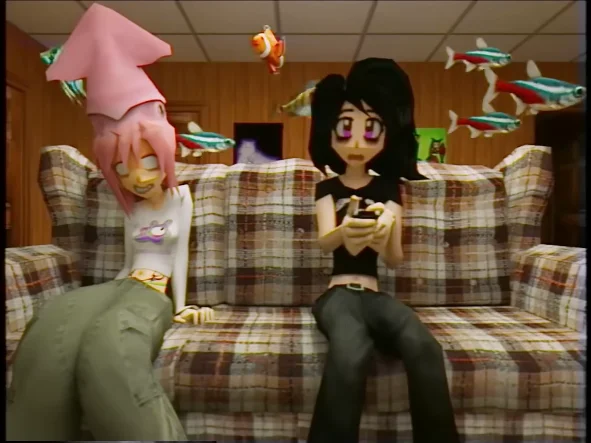
He shared some messages he sent to a friend after he watched GeoH3x’s “Salem & Squid: Fish Channel” with a friend, and then I asked him some questions about the PS1 aesthetic through a short semi-structured interview. The video shows Salem sitting in a living room in front of a CRT playing bright clouds and blue sky with breakbeat music, while a greenscreened dancer slides around on top of the background using simple animated transforms to the music. Squid enters and teases Salem about her stillness and tired look, which shifts into a back-and-forth about restlessness, sleep, and possibly seeing things. Visual oddities pile up – static, fried eggs, a squid emerging from Squid’s hair, and fish pouring out of the television before dropping to the floor. The TV punctuates the scene with a jarring phrase, and throughout the exchange Salem remains uncertain about what is real while Squid leans into the surreal energy. This balance between everyday domestic space and unsettling overlays mirrors the cozy/creepy spectrum already discussed in the paper, and it became the exact moment that drew Fave into the aesthetic and opened the door for our later conversation about how it shapes his own tastes and routines (Fish Channel, follow-up video).

When looking at the messages Fave shared from his conversation with a friend over GeoH3x’s “Salem & Squid: Fish Channel,” his allegiance to these characters arrived immediately and loudly: “SALEM ALL THE WAY,” with Squid close behind. The lines from the animation became day-one in-jokes. The mood of this episode places it into the “cozy vs creepy” continuum already outlined in the paper: soft lighting, gentle surreality, the unhurried domesticity of the pair of characters. It wasn’t just delight, though. Through the conversation with the friend, Fave was able to name the feeling as anemoia – a nostalgia for a time one never lived. For this PS1 aesthetic, it centers around the late 1990s and early 2000s across the U.S. and Japan. Born in 2000, he described having “just barely missed that mark,” which sharpened the sense of proximity to a world of mall trips, America Online Instant Messenger (AIM) status messages, and college-age nights that felt slower and freer than now.
Fave grew up in a dangerous, low-income neighborhood; simple roaming wasn’t an option, and the 2008 downturn tightened what was already tight. Looking back, he framed adolescence as being “locked out” of routine teenage rituals, ones where he would have been able to spend a few dollars at a gas station with friends or buy small bits of fashion to try on an identity. GeoH3x’s video did not implant desire so much as open a gate to pleasures that once felt out of reach. This reminds me of what we talked about with medium-specific noise: just as artists add CRT bleed or polygon jitter to evoke a feeling, Fave found that a lo-fi morning in a dream-like kitchen could authorize small, real changes in pace and habit.
When I was asking questions during my semi-structured interview with him, those changes resolved into plans. I asked which elements of the era they’d actually want in their life, and Fave answered, “all of it.” Techno and electronic alongside rock and goth; mall life; the social ease of AIM; midnight-to-3 a.m. drives with a like-minded passenger and stopping by the gas station. I was interested in who would be the passenger, and he chose Salem. With a little expendable money, they’d pick up clothes that fit Salem’s vibe but read as his own, and maybe a cozy touch for the home PC.
Some of this is already in motion. After seeing Salem open a fridge on an ordinary morning, Fave started keeping one beer cold “for the right moment.” He put on NakedFlame (who is featured in the soundtracks of some of the GeoH3x videos) while tidying. They want warmer colors at home, a lava lamp, and a nudge away from a too-modern apartment toward a room with more personality. In other words, the everyday practice mirrors what this paper traced in contemporary works: a cozy palette, sincerity without irony (akin to the “Kindness Luigi” hopecore warmth), and it all runs through low-poly’s capacity to make small, ordinary things feel intentional.
Crucially, Fave’s interest isn’t only retrospective. It’s also a trajectory that points forward. He wants to make arcade games and talks about it in terms of skill-building: a ladder from Pong to a Galactica-like shooter to Breakout/Arkanoid to a top-down 2D RPG, then into 3D with Godot or Unreal, with a distant dream of writing a renderer. The plan treats constraint not as a wall but as scaffolding, echoing this essay’s through line: limits generate style. Where indie creators in our survey use low resolution, tiny textures, and wobble as expressive choices, Fave treats those limits as a curriculum – steps toward learning code and game design.
Fave lives alone and values what that enables. He is happier now than during a recent stint abroad; the pleasure is in building a home and a routine that reflect who they are. The style becomes a way for him to allow himself to branch out: it lets him buy the small things, rehearse youthful rituals he missed, and set a mood that matches the person he wants to be with others. When I asked whether the aesthetic is a mirror for a life he wishes he had lived or a language for who they are now, Fave said it’s both. It’s a window onto a wished-for past and a grammar for the present. “I feel like a kid again,” he added, meaning it as a good thing.
Taken together, notes from a casual chat among two friends and our follow-up compress the paper’s argument to the scale of one person’s engagement with the medium. The aesthetic moves from historical limitation to contemporary media to lived routine; it’s not merely a look one watches, but a lifestyle one inhabits. With that example in view, we can now return to the larger claim the conclusion advances: that the PS1 low-poly style has matured from constraint into a durable language for making and for living.