Witnessing
Slow Art as Observation and Presence. The final lens, witnessing, centers on the simple but powerful act of paying sustained attention. This is slow art that asks for stillness and watchfulness: to witness a process or moment in real time, often for longer than one normally would, and sometimes to capture it through art. Unlike the performative lens (where something is actively being done or played) or the pilgrimage lens (where one actively travels), witnessing is more passive: the art unfolds by itself (or by nature), and the role of the “artist” or viewer is to be there and observe or record it. This could be a photographer exposing a single frame for hours to capture star trails across the sky, or an artist setting up a time-lapse camera to compress a week of plant growth into a few seconds of video. It could also be a person just sitting quietly to watch the full progression of a sunset, treating that experience as the artwork. In witnessing, time itself is the medium and patience the primary tool. The reward of this slow art is a heightened sense of awareness. It entices us to notice subtle changes that usually escape us in daily rush. It teaches the art of seeing: how much more we perceive when we simply stop and look for an extended interval. In a way, witnessing blurs the line between creator and observer; to witness well is to participate in the creation of an experience.
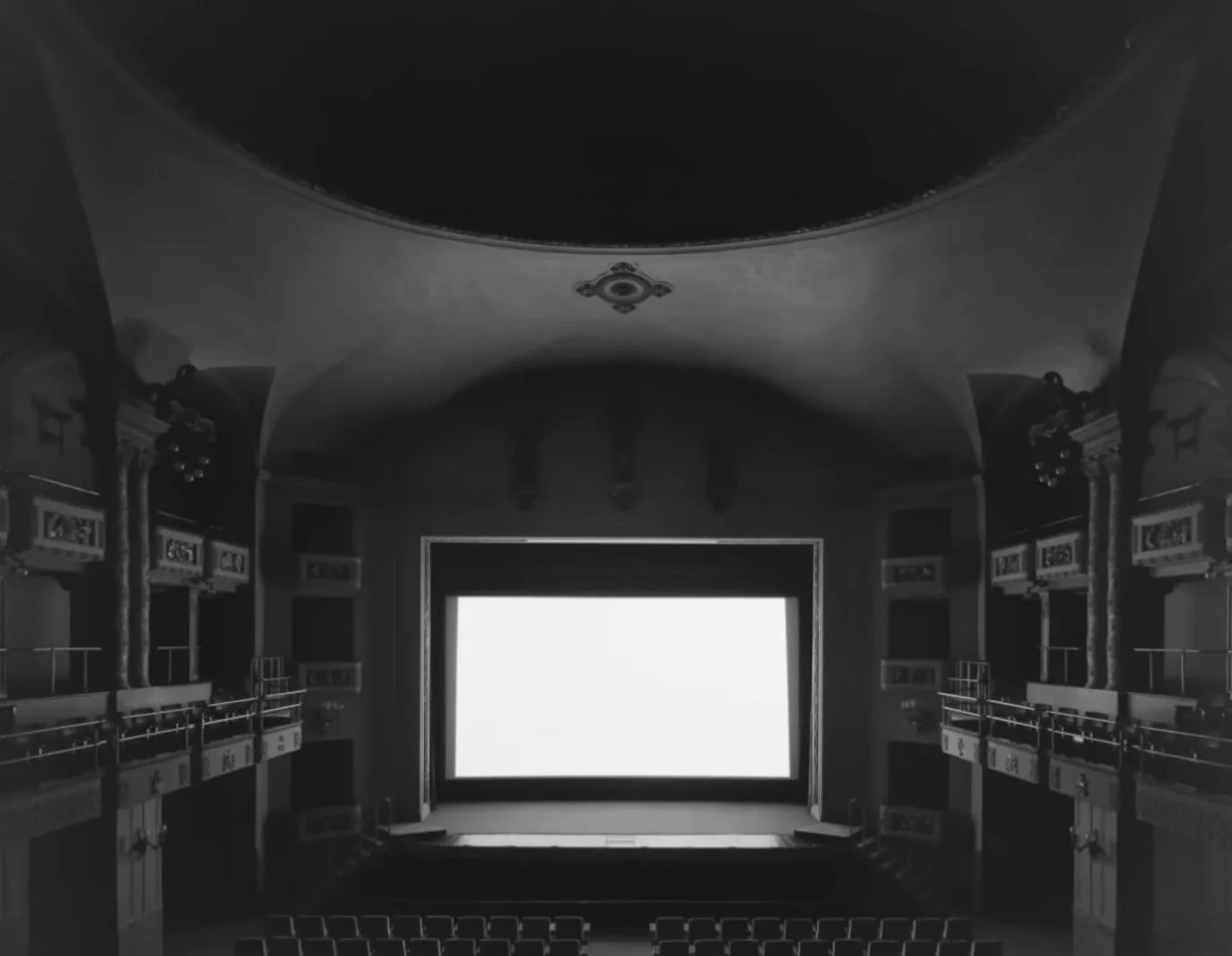
Hiroshi Sugimoto’s Long-Exposure Photographs: A compelling illustration of the witnessing approach is the work of photographer Hiroshi Sugimoto, particularly his famous Theaters series (Sugimoto’s series). In the late 1970s, Sugimoto took his camera into old movie palaces and drive-in theaters. He wasn’t there to document the architecture. He was there to capture time passing. Sugimoto set up a tripod, framed the ornate theater with its screen at center, and at the start of a film he opened the camera’s shutter… then he simply waited through the entire movie, only closing the shutter after the last credits rolled. The result? A single photograph that contains within it the whole film. Because the movie’s images were projected frame after frame onto the screen, their light cumulatively exposed Sugimoto’s film. The screen in each photo appears as a rectangular blaze of pure white – all the action, all the drama condensed into one featureless glow. Meanwhile, the theater around it is illuminated in ghostly detail by that light. These black-and-white images have an eerie serenity: the audience seats are empty (Sugimoto often did this in empty cinemas to avoid any blur of moving people), the architecture sharp, and the glowing screen almost spiritual, like a portal. Sugimoto effectively witnessed the entire movie in one frame. The ghostly pallor of those images is a direct product of slow technique – leaving the shutter open for a two-hour exposure. This is photography not as a split-second snapshot, but as a meditative recording of duration. We see a similar ethos in long-exposure star trail photos, where leaving the camera open for hours at night yields circular arcs in the sky, showing the Earth’s rotation. Or consider timelapse films (the opposite technique in some sense, stitching together many quick frames taken slowly to show a fast playback): a flower blooming in seconds on screen that actually took days, or a construction project erected in a minute’s montage though it lasted a year. These are artistic ways of witnessing change beyond normal human perception. Even slow-motion footage – say, a hummingbird’s wings slowed down – can be a form of witnessing by altering time scale to reveal hidden structure. At the core is an intention to see more than meets the fleeting eye. Sugimoto’s work in particular poses a philosophical question: if you compress time or stretch time through art, what new truths appear? By getting an entire feature film in one frame, he invites us to see the unity in what was a sequence. The white screen suggests that all stories, when summed up, perhaps share a luminous sameness, or that the details of narrative are ephemeral, leaving behind just light. It also comments on the nature of cinema itself: these theaters are literally “temples of time,” and Sugimoto’s camera captures that worship of light and time in a single still image.
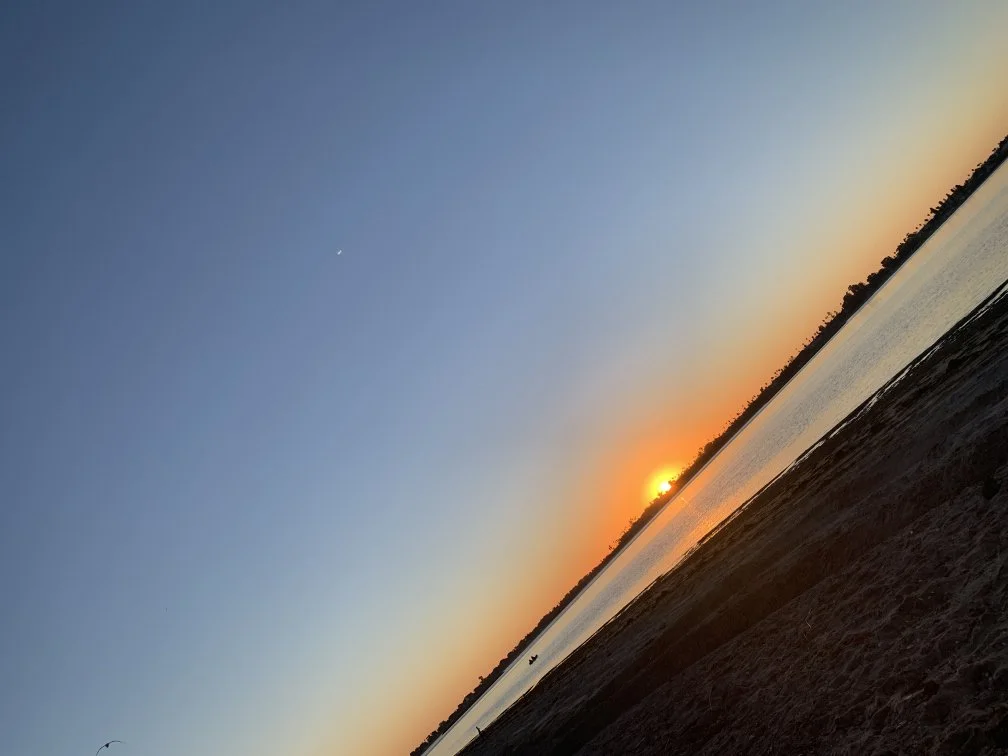
Sunset Vigil: Practicing the art of witnessing can be as humble as deciding not to pull out your phone for a while and instead devoting your full attention to something normally taken for granted. I recall a day I did this with the most everyday of spectacles: a sunset. It was during a particularly hectic week at school; my mind was buzzing with to-do lists and worries. That evening, I was biking home and noticed the sky starting to tint orange. Normally, I might glance for a second, think “pretty sunset,” and return to whatever I was doing. But that day I felt an urge to truly be present for it. I noticed how the clouds caught the light, how the cool breeze felt on my face. About halfway to the spot where I lock my bike, a shift happened. My breathing slowed. I noticed how the light was changing in real time: the golden hour glow deepened to amber, then to a fiery orange. Wisps of clouds that had been pearly white turned cotton-candy pink, then molten gold, then gray. By the time that bright disk was halfway gone, half hidden by distant buildings and clouds, I felt a profound sense of calm. I realized I hadn’t truly watched a full sunset, start to finish, in a very long time. It was quietly exhilarating to witness this everyday cosmic event with sustained attention. No two moments of it were the same, yet it was so gradual – a perfect slow art performance by nature. After the last sliver of sun disappeared and twilight began to spread, I stayed a little longer, watching the first stars peek out. In a sense, I turned a regular evening into a kind of personal art installation simply by choosing to witness it fully. What might you discover if you set aside a slice of time to purely witness something? It could be as grand as a meteor shower or as humble as the way shadows move across your living room wall. Consider yourself the artist and the observer at once – by devoting attention, you transform the act of seeing into a slow, meaningful art. In a life filled with distractions, what “ordinary” phenomenon could you turn into an extraordinary experience, just by watching it with patience?