Introduction: Clothing, Naming, and the Problem of Categories
When I say I crossdress, the first question is what I am actually describing. I don't usually present in a way that people would read as trying to be a woman, but I do appreciate the flow of fabrics, especially skirts and dresses. I wouldn't particularly be interested in pencil skirts or other tight-fitting dresses, though some of my wardrobe has those styles, like jean skirts that have stiffer fabric and end up being less flowy by material constraints rather than the fullness of the fabric (I actually made a pair out of ill-fitting jeans).
I sometimes use the word crossdressing to explain my experience because it does a lot of the lifting, explaining that my fashion sense is not aligned with society's expectations of my cisgender male identity. The interesting thing is that I can only expect them to know my identity based on my presentation. From my understanding, presentation isn't just clothes. For example, I don't use effeminate inflection in either my voice or body language. By effeminate I mean the voice, posture, gesture, or movement patterns people tend to conventionally read as feminine (not a fixed or natural way any gender has to sound or move). When I dress up in fashion, I don't really see it as a connection or expression of my gender. At times I may even identify with the label Agender, but I've always been comfortable with cisgender male, even during the periods in which I may or may not use the label Agender to describe portions of my identity.
Crossdresser, however, is a word I've personally reclaimed, and as someone who crossdresses, that's something I suppose I'm allowed to decide for myself. It's fun to reclaim a term, especially when it's literally something I use as a quick way to explain myself without having to go on for a few thousand words as I will do in this research paper. I feel the playfulness of the word, and the best part about crossdresser is that it is not inherently gendered. Crossdressing "goes beyond" the flattened assumption that it is only about dressing as some supposed opposite, and is more elegant in my eyes.
The 'cross' in crossdressing carries the sense of crossing an imagined line, or going "across" and "beyond" prescribed social boundaries. 'Dressing' carries the sense of preparing, arranging, or putting something in order. So crossdressing, in this paper, is not only about what category the clothes came from. It is also about arranging myself across and beyond the social boundaries that were prescribed for me. So going beyond the social boundaries is what I am doing, and that feels quite epic.
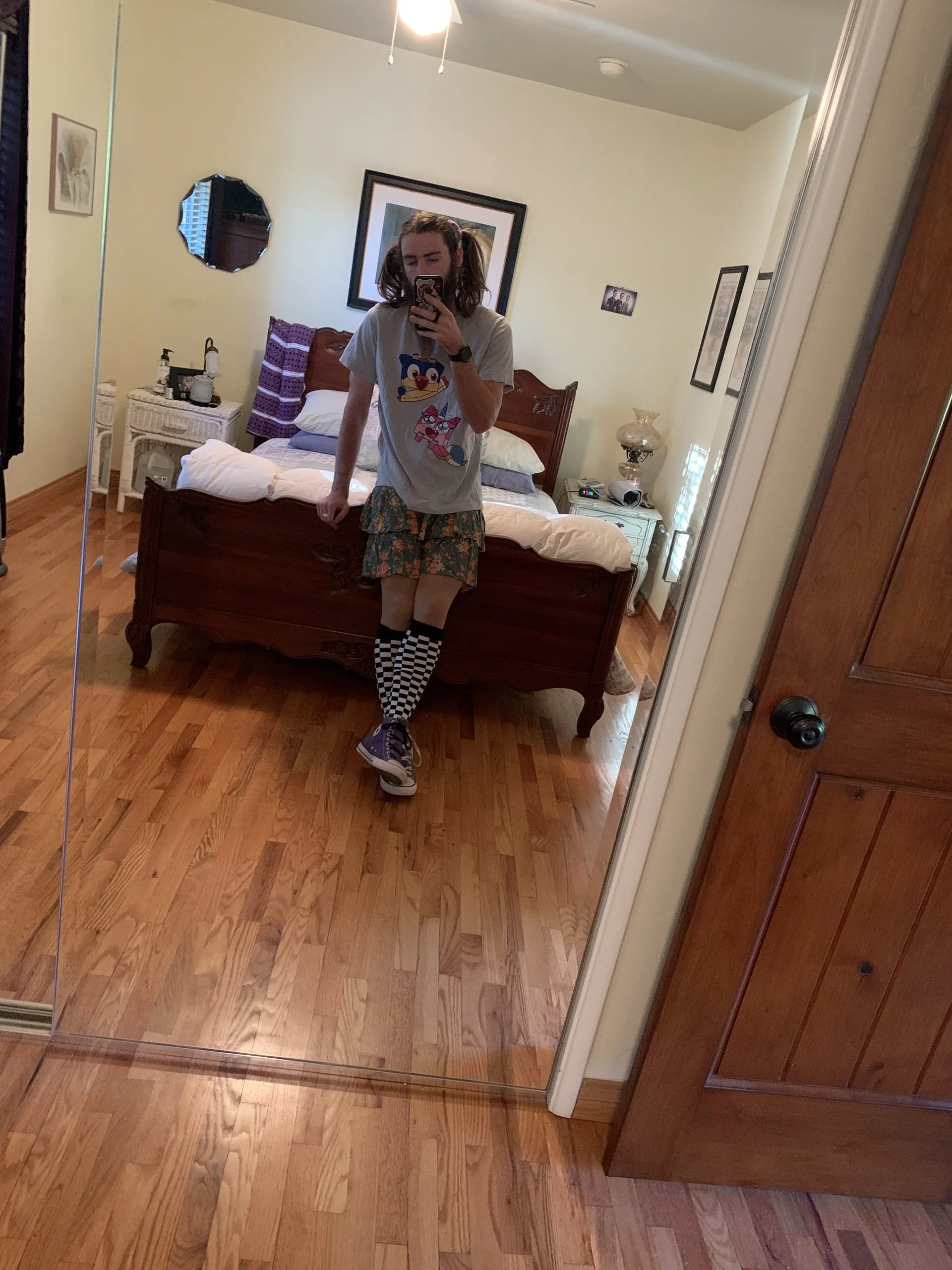
This is why the simplest statement is also the core of the whole paper: I wear what I like. Crossdressing is very heavy on aesthetics and self-expression for me, and those aesthetics show up everywhere: in the art I notice, the costume design I focus on, the game character customization I enjoy, and the clothes I reach for in my own wardrobe. But the moment those preferences enter public life, they are no longer treated as just preferences. They get filtered through gender, language, dress codes, assumptions, and social comfort.
The meaning of crossdressing also changes by place. There are places that I've crossdressed to so often that I would feel odd (and people in those areas would notice the change) to dress up in more masculine attire. I would feel out of sync with myself, or out of place, since that location is so well traversed for me in my alternative attire. So the practice is not only a private preference or a single public gesture. It is a wardrobe, a routine, a way I move through familiar places, and sometimes a way I avoid places where the social backlash feels like too much friction.