IV. Being Read as Male, Being Misread, and Pronouns
When people glance at me and categorize me as male because of facial hair, body language, or voice, that feels accurate. I don't mind. I think it's amusing when clothing does interrupt categorization, especially because I prefer people to get to know me, even if I start off by telling them labels I identify with. I go beyond the labels, though they are tools I use to get to a bare minimum understanding of me.
In person, I do feel misread when someone assumes I am trying to look like a woman, though that does not happen much because I am not usually arranging my presentation around being read that way. Online, I think it's great and don't mind at all if people use or assume she/her pronouns for me. I don't ask them to, but if they do, it doesn't bother me in the slightest. My online persona is quite different from my irl one, and it is not constrained to many of the unavoidable parts of being in the real world. Online is also where I mostly enjoy ambiguity and anonymity.
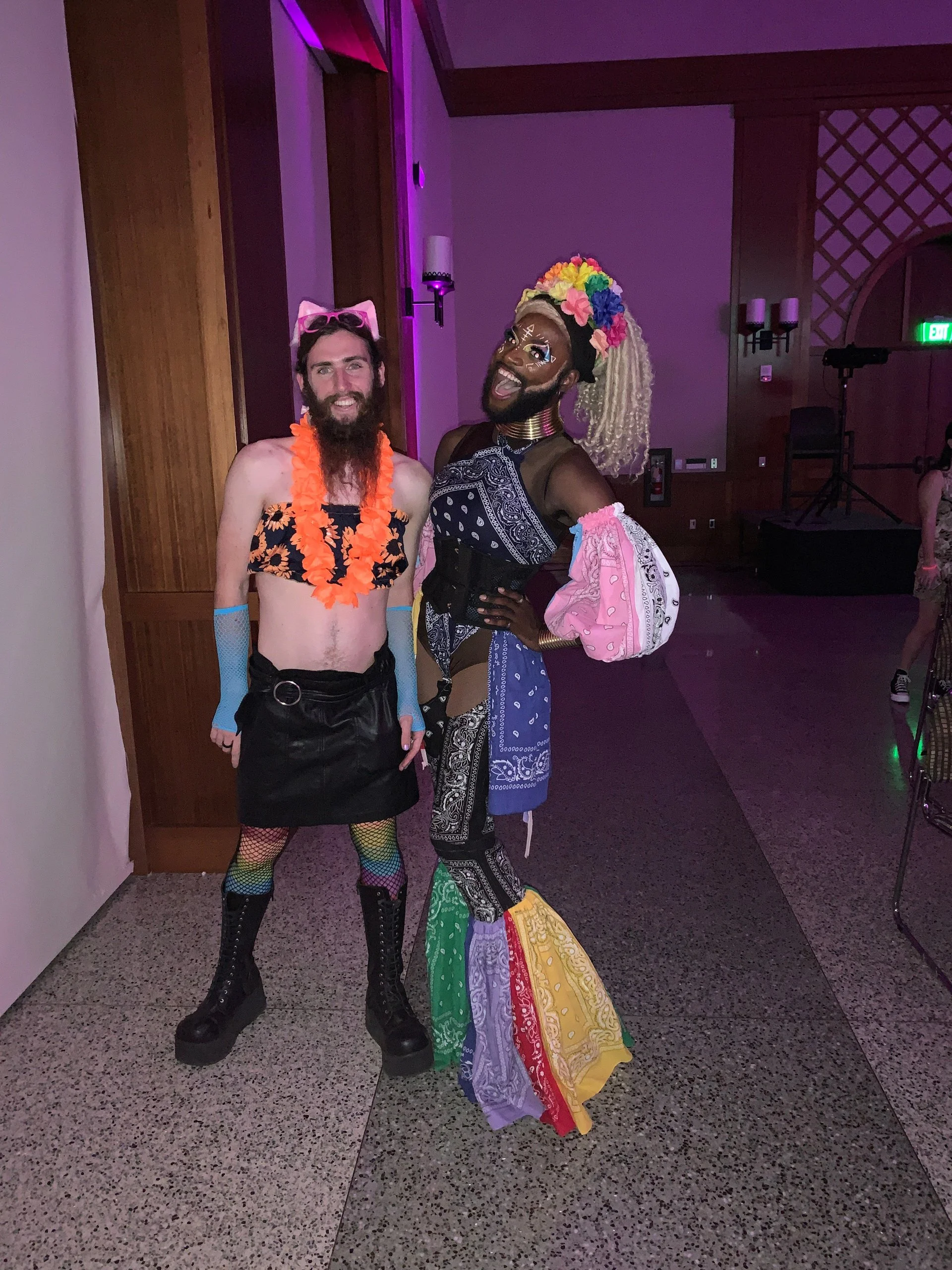
Another possible misreading is drag. I like the look of drag but I wouldn't perform it, mainly from my reservations in body movement and makeup. I do get a handful of people thinking that the way I dress is somehow associated with my politics or that I'm making a political statement. It really isn't, because of my avoidance of those elevated levels of social friction. Since I'm choosy about where I crossdress, it's not often that this misinterpretation gets voiced to me directly, but when it does I never know how to respond because it isn't false that I believe that people should be able to dress outside of the assumed gender binary (or crossing it). It's just that my act of putting on my daily wear clothes is not, by itself, any particularly planned social outcry. It just so happens that my politics on that subject line up with my current dress (or skirt, haha) because that's already what I would prefer to wear. And NOT that I'm pointedly wearing it to voice that statement.
I prefer he/him pronouns. I only really tell people when asked. Otherwise they seem to start off with he/him for me based on the rest of my presentation. Fashion doesn't seem to (experientially/anecdotally) have enough weight on its own to get their assumptions to shift toward other pronouns when referring to me. I don't want people to assume my clothing says anything about my pronouns. If they use they/them pronouns for me exclusively because of my outfit, that would be a bit annoying because the singling-out is the part that bothers me, not the pronouns themselves. However, if they use they/them pronouns often by default (I have picked that habit up), then it's fine if they use they/them for me, but I don't offer it as a preference when asked.
I also don't want people to assume that clothing alone tells them whether I am trans, or that choosing a dress means choosing womanhood. I don't think many people make that assumption about me, but the problem would not be being perceived as trans, as though transness is bad… The problem would be the shortcut. People often treat certain garments as if they automatically point toward a gender identity or personal history, and that is the part I do not know how to fully undo in other people (people can understand the distinction logically, but their first reaction may still follow older social habits). For me, though, the appreciation stays with the garment design rather than the gender category people attach to it.
That focus on garment design does not mean I ignore the contexts those garments can carry. I know some clothes and presentations can be used in marketing in objectifying ways, which is upsetting most certainly. I know that there are double standards. But in my worldview, when I see clothes, I can just be interested in their design, their creation (I sew, after all), their style, and what they do or do not cover. It doesn't attract me more or less to any individual (since I have no attraction as a blanket statement), so it just ends up being a delightful variation when I see different people in different outfits.
The uniqueness, self-expression, diversity, I love it all. I try to notice style as a whole: body type, race, posture, hairstyle, tailoring, movement, comfort, confidence, and all the little choices that make an outfit feel like a person instead of a mannequin. That’s all a part of the appreciation, too. Whether someone is experimenting, settling into themselves, dressing for comfort, dressing for survival, crafting a look they want, or moving toward a body or presentation that feels more like home, I want to be able to celebrate them, be with them at their lows, show them that I care at every stage, all of it.
If others ask about my intent, they can make a conversation, though if they don't go into the conversation open minded then I struggle with finding the effort to continue advocating if they aren't someone that I would associate with much in the future. If they are, then it's worth the effort to fight uphill. Otherwise, I find that my favorite conversation partner would be one that delights in my attire and wants to know more about my fashion sense or share theirs (even if it is different than my fashion sense).