A Virtual Girl

@katsumi_maki
A Virtual Girl.
Pronouns and words are separated between In-person, Online, or In-person/Online. In-person only infers that the term is not really for online (and vice-versa). Terms that are Okay are for terms you shouldn't go out of your way to refer to me with, but it's fine if you do by habit.
Avoid and Never are for words or conversation topics to either avoid (or approach with caution) or never talk about, respectively.
Age: 26
My local time is loading…

A Virtual Girl was a moniker I made up, not at first for myself but initially for my character, Daisy. It never made it into the worldbuilding document (notes I make for myself when the universe is entirely self-authored) and only showed up a single time in the book, about halfway through. But in the meantime it became a sort of branding for me. It’s what I put on all my online bios, the short description being succinct.
That was very early on in my understanding of gender, but even back then, in high school, I knew that A Virtual Girl was something that I felt very comfortable with. Technically, Daisy was the original Virtual Girl before I assumed that as my own label. Daisy started off as a self-insert (the author putting themselves into the story through a character) but became her own character as the novel went through a power creep of one-upmanship. Power creep is when a story keeps escalating abilities, stakes, or spectacle until characters become much more extreme than they were at the start. Basically, Daisy slowly became a god in the story, so she became less relatable and started having conflicts that were no longer aligned with my own experience.
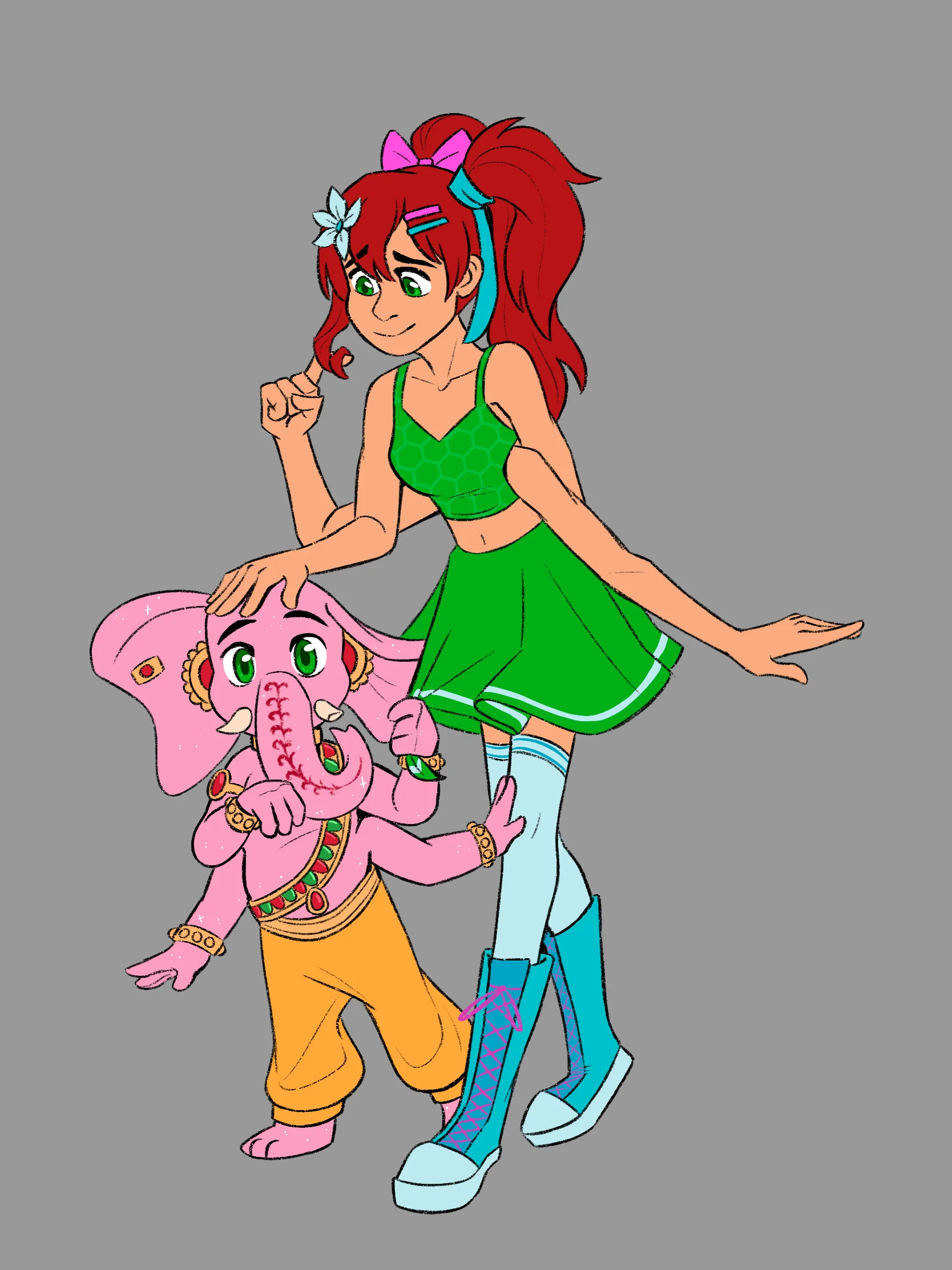
The phrase “A Virtual Girl” is descriptive in a way that I don’t think is very easy to explain otherwise. The virtual part of my virtual girl descriptor is literally just that: an online persona that is girl. But more specifically, it is that I am a virtual girl. My online persona, which exhibits many traits of what people may deem “chronically online,” is a virtual girl.
Chronically online individuals, at least in the way I express those traits, would include “internet slang,” but even beyond that to “rawr speech” or “XD” language, whatever part of the internet you’re in might call it. Let’s unpack and learn about those terms. A tiny history lesson, compliments of a Nick Robinson video about “XD”: the mid-2000s internet had a loud, messy, hyper-expressive style of writing that felt distinctly young and online. Messages often looked rushed or deliberately chaotic, with emoticons, repeated punctuation, random exclamation marks, and frequent use of XD doing much of the emotional work. The text was not just communicating information; it was performing a personality: silly, annoying, excited, unserious, and self-consciously childish. This style came from a wave of young users entering online spaces that had previously felt smaller and more closed-off. Their writing brought a new kind of energy: messy phrasing, exaggerated reactions, inside-joke slang, and a tone that could seem irritating. The result was a recognizable early-internet voice: cluttered, emotive, immature, and expressive in a way that made the text itself feel ironically aware of its immaturity.
Now I’m not saying that my messaging style is full-force like this, but it can certainly lean into the more chaotic style messaging, especially if the messaging partner is receptive or especially participates in the type of, well, “eloquence” that is so specific to the internet and retained within a few fandoms (such as the furry fandom) long after the decade it sprung up in has passed. All in all, that’s what makes my virtual counterpart so much of their own person that they get a new label: A Virtual Girl.
She feels like a spirit, a mindset, and at times, a companion. She can even feel like a daughter to me, where I grow protective over her, and thus draw boundaries that are just healthy for my own mental state, but in the name of protecting her. I treat her better than I treat my real self, which is unfortunate to say, but she’s also me, so it’s at least still a positive.
The playfulness is a big part of it. I will often roleplay, so much so that it enters normal dialog. Specifically, roleplay that uses action words, as seen by italic text or just text *surrounded by asterisks*. Like *Boops you* if I want to take my virtual finger and press it playfully against their nose. I’ll usually follow it up with an unitalicized “Boop!” to let them know I also said the word “aloud” as I did the action. Big feelings on the playfulness of it, especially when others are receptive and encourage the play.
Knowing that my internet self can connect with others in a “girlies” way, as the group terms suggest, is a very nice way to affirm them and also feel like my playful internet self that has found their own way online, just as I have found my own way in the real world as a person. “Girlies” and “queens” are affectionate group terms common in some queer and internet spaces. I use them here as playful forms of inclusion, not literal assertions about everyone’s gender within a group.
@katsumi_maki
Words
Honorifics
- Ms.
- Ma’am
- Madam
- Princess
Ways to refer to me
- girl
- girlfriend
- bbg
- boo
- sister
- darling
- princess
- daughter
- honey
Group terms
- girlies
- ladies
- queens
I would love for others to envision me as a virtual girl. They might not have the same point of view that I do, since I know my virtual girl self just as much as I know my real life self. I’m extremely introspective, if this thousand-word paper about myself, not to mention nearing ten papers like it about human psychology and my personal history, is any clue. But in the same way that I can affirm others by being like “queeeeen, you right,” I feel like it gives me a boost of energy if they do the same for me. It’s heavily in queer spaces, but I’ve been mistaken for an internet girl in spaces that have other common interests (though still a large body of queer users because that’s just my go-to on the internet) even if it’s about a particular fandom we all enjoy.
That is why she/her is online-only: it belongs specifically to the virtual-girl context. It also explains why “girl” ties very deeply into the phrase “A Virtual Girl,” even if the people using “girl” to refer to me don’t know about my ownership of that phrase. It also explains why “bbg,” meaning “baby girl” specifically, works as an extension and acronym for girl when directed at me. ‘bbg’ is internet shorthand that can be affectionate, teasing, flirtatious, or sexual depending on context. On my page, I mean the nonsexual version. It’s playful, quick to type, and hits the virtual feminine vibe that I encourage and live in for online spaces I’m a part of. Sure, it means other things, but I know what relationship I have with people who use that for me.